Key Themes in the Book of Psalms: Comfort, Praise, and Lament for Personal Growth
Overview of Psalms' themes—comfort in trials, praise in joy, and honest lament. Tools for personal spiritual growth.
Beloved in Christ, the Book of Psalms stands as one of the most beloved portions of Holy Scripture, a rich treasury of human experience laid bare before the throne of God. The key themes of comfort, praise, and lament weave through its 150 chapters, inviting every believer into a deeper relationship with the Lord. These themes are not isolated but interconnected, reflecting the full range of the Christian life—seasons of joy, sorrow, worship, and trust. They align with the broader biblical narrative of God's covenant faithfulness: from the cries of Israel in bondage, through the prophetic promises of restoration, to the ultimate fulfillment in Christ Jesus, who Himself quoted the Psalms in His hour of greatest need.
The Psalms teach us that honest expression before God—whether in exuberant praise, desperate lament, or quiet comfort—is essential for spiritual maturity and personal growth. They model a life of dependence on the Lord, showing that growth comes not in avoiding hardship but in bringing every emotion to Him in faith.
Scriptural Exposition
Let us turn to the sacred text itself, drawing primarily from the King James Version while noting parallels in the New King James Version for clearer understanding in modern English.
First, the theme of praise permeates the Psalms as the proper response of the creature to the Creator. Psalm 100:4–5 (KJV) declares: “Enter into his gates with thanksgiving, and into his courts with praise: be thankful unto him, and bless his name. For the LORD is good; his mercy is everlasting; and his truth endureth to all generations.” In the NKJV: “Enter into His gates with thanksgiving, and into His courts with praise. Be thankful to Him, and bless His name. For the LORD is good; His mercy is everlasting, and His truth endures to all generations.” This call to joyful adoration sets the tone for many psalms of pure praise, such as Psalm 145–150, which form the great Hallelujah chorus concluding the Psalter.
Second, lament occupies a surprising prominence—nearly one-third of the Psalms express grief, confusion, or pleas for deliverance. Psalm 22:1–2 (KJV), quoted by our Lord on the cross, cries: “My God, my God, why hast thou forsaken me? why art thou so far from helping me, and from the words of my roaring? O my God, I cry in the daytime, but thou hearest not; and in the night season, and am not silent.” The NKJV renders it: “My God, My God, why have You forsaken Me? Why are You so far from helping Me, and from the words of My groaning? O My God, I cry in the daytime, but You do not hear; and in the night season, and am not silent.” Yet even in lament, hope emerges, as the same psalm turns to trust in verse 24: “For he hath not despised nor abhorred the affliction of the afflicted; neither hath he hid his face from him; but when he cried unto him, he heard.”
Third, comfort flows from the Lord's presence and promises. Psalm 23:1–4 (KJV) offers one of the most cherished passages: “The LORD is my shepherd; I shall not want. He maketh me to lie down in green pastures: he leadeth me beside the still waters. He restoreth my soul: he leadeth me in the paths of righteousness for his name's sake. Yea, though I walk through the valley of the shadow of death, I will fear no evil: for thou art with me; thy rod and thy staff they comfort me.” In modern phrasing (NKJV): “The LORD is my shepherd; I shall not want. He makes me to lie down in green pastures; He leads me beside the still waters. He restores my soul; He leads me in the paths of righteousness for His name’s sake. Yes, though I walk through the valley of the shadow of death, I will fear no evil; for You are with me; Your rod and Your staff, they comfort me.”
Another profound source of comfort is Psalm 46:1–3 (KJV): “God is our refuge and strength, a very present help in trouble. Therefore will not we fear, though the earth be removed, and though the mountains be carried into the midst of the sea; though the waters thereof roar and be troubled, though the mountains shake with the swelling thereof.” The NKJV: “God is our refuge and strength, a very present help in trouble. Therefore we will not fear, even though the earth be removed, and though the mountains be carried into the midst of the sea; though its waters roar and be troubled, though the mountains shake with its swelling.”
Finally, Psalm 34:18 (KJV) assures: “The LORD is nigh unto them that are of a broken heart; and saveth such as be of a contrite spirit.” NKJV: “The LORD is near to those who have a broken heart, and saves such as have a contrite spirit.”
These verses reveal that praise, lament, and comfort are not competing emotions but complementary movements in the symphony of faith.
Reflective Insights
The Psalms refuse to present a sanitized spirituality. They teach us that authentic worship includes bringing our rawest emotions to God. David, the primary author under the inspiration of the Holy Spirit, models this: one moment he blesses the Lord with his whole heart (Psalm 103), the next he pleads for deliverance from enemies who seek his life (Psalm 56). This honesty reflects the truth proclaimed in Proverbs 14:13 that “even in laughter the heart may sorrow,” and Ecclesiastes 3:4 that there is “a time to weep, and a time to laugh; a time to mourn, and a time to dance.”
In the New Testament, Jesus embodies the Psalms. He sings them in worship (Matthew 26:30), prays them in Gethsemane, and cries them from the cross. The Apostle Paul, quoting Psalm 116, reminds us that faith is expressed in both distress and deliverance (2 Corinthians 4:13). The book of Revelation culminates with heavenly worship echoing the Psalms, showing that praise will be our eternal occupation.
Philosophically, the Psalms confront the problem of suffering head-on. Job's questions find voice here, yet the Psalter moves beyond mere complaint to trust. Lament is not unbelief; it is belief wrestling with reality in the presence of a sovereign God. As the writer of Psalm 73 confesses, only when he entered the sanctuary of God did he understand the end of the wicked and the security of the righteous.
For personal growth, these themes shape us into mature believers. Praise enlarges our vision of God, preventing idolatry of self or circumstance. Lament teaches humility and dependence, guarding against superficial faith. Comfort reminds us of God's nearness, producing perseverance and hope that “does not disappoint” (Romans 5:5). Together, they form us into people who, like Christ, can say both “Not my will, but Yours be done” and “Into Your hand I commit my spirit.”
Practical Applications
To apply these themes in daily life, consider the following guided devotional worksheet with ten reflective prompts. Use it individually, in small groups, or under pastoral guidance. Spend time in silence after each question, then journal your responses and pray.
- Read Psalm 100 aloud. What specific attributes of God stir your heart to praise today? List three and thank Him for each.
- Recall a recent circumstance that caused you sorrow or fear. Using the pattern of Psalm 13, write your own short lament: (a) honest complaint, (b) request for help, (c) declaration of trust.
- Meditate on Psalm 23:4. In what “valley” are you currently walking? How does the presence of the Shepherd comfort you practically this week?
- Identify one enemy of your soul (fear, bitterness, distraction). Pray Psalm 46:1–3 over it, declaring God as your refuge.
- Read Psalm 34:1–10. Commit to “bless the LORD at all times” today. Set three reminders on your phone to pause and offer brief praise.
- Reflect on a time God turned your mourning into dancing (Psalm 30:11). Share this testimony with one other believer for mutual encouragement.
- Examine your prayer life: Does it include more praise, lament, or requests for comfort? How might balancing these deepen your intimacy with God?
- In light of Psalm 51, confess any known sin that hinders free expression before God. Receive His forgiveness and restoration.
- Choose a lament psalm (e.g., 42, 77, or 88). Notice how even the darkest ones often end with hope or resolve to trust. What does this teach about perseverance?
- Pray Psalm 19:14 as a closing benediction: “Let the words of my mouth and the meditation of my heart be acceptable in Your sight, O LORD, my strength and my Redeemer.”
Guided Prayer:
Heavenly Father, You who hear the cry of the afflicted and inhabit the praises of Your people, teach us to bring every emotion to You. When we are overwhelmed, be our refuge; when we are joyful, receive our worship; when we are broken, bind up our wounds. Conform us to the image of Your Son, who prayed the Psalms perfectly. In Jesus’ name, Amen.
Key Takeaways and Study Plan
Key Takeaways:
- The Psalms validate the full spectrum of human emotion as acceptable in God’s presence.
- Praise magnifies God’s greatness and reorients our perspective.
- Lament is an act of faith that refuses to pretend all is well when it is not.
- Comfort is rooted in God’s unchanging character and nearness, not in the absence of trouble.
- Honest engagement with these themes produces spiritual maturity and deeper trust.
- Jesus Christ fulfills and embodies the Psalms, making them our own through union with Him.
- Corporate and personal worship should reflect all three themes for balanced Christian life.
7-Day Study Plan:
- Day 1: Psalms of Praise – Read Psalms 145–147. Journal attributes of God worthy of praise.
- Day 2: Personal Lament – Read Psalms 13, 42. Write and pray your own lament.
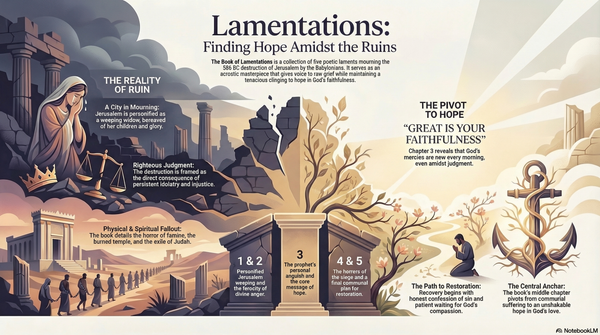
- Day 3: Communal Lament – Read Psalm 137 and Lamentations 3:19–26. Reflect on corporate grief.
- Day 4: Comfort in Trial – Read Psalms 23, 46, 91. Memorize one verse for meditation.
- Day 5: From Lament to Praise – Read Psalm 22 completely. Trace the movement from despair to hope.
- Day 6: Messianic Psalms – Read Psalms 2, 110, and Hebrews 1. See Christ in the Psalter.
- Day 7: Living the Psalms – Choose one psalm reflecting your current season and pray it throughout the day.
Conclusion
Dear friend, the Book of Psalms is God’s gift to guide us through every season of life. In its pages we find permission to be fully human while being drawn ever closer to the divine. Comfort, praise, and lament are not merely themes to study but practices to live—pathways that lead to personal growth and deeper communion with the Lord who hears, who reigns, and who redeems.
I encourage you today: open your Bible to the Psalms and begin. Let David’s words become your words. Bring your whole heart to God, trusting that He is near to the brokenhearted and inhabits the praises of His people. May the Lord bless you and keep you as you walk this ancient yet ever-new path of faith.
In the name of Jesus Christ, our Great Shepherd and Eternal King, Amen.