The Book of 1 Samuel: Transition to Monarchy — Samuel, Saul, and the Rise of David
Complete overview of 1 Samuel — from Samuel's birth and leadership, the rise and fall of King Saul, to David's anointing and triumphs, highlighting God's sovereign choice of leaders.
Summary
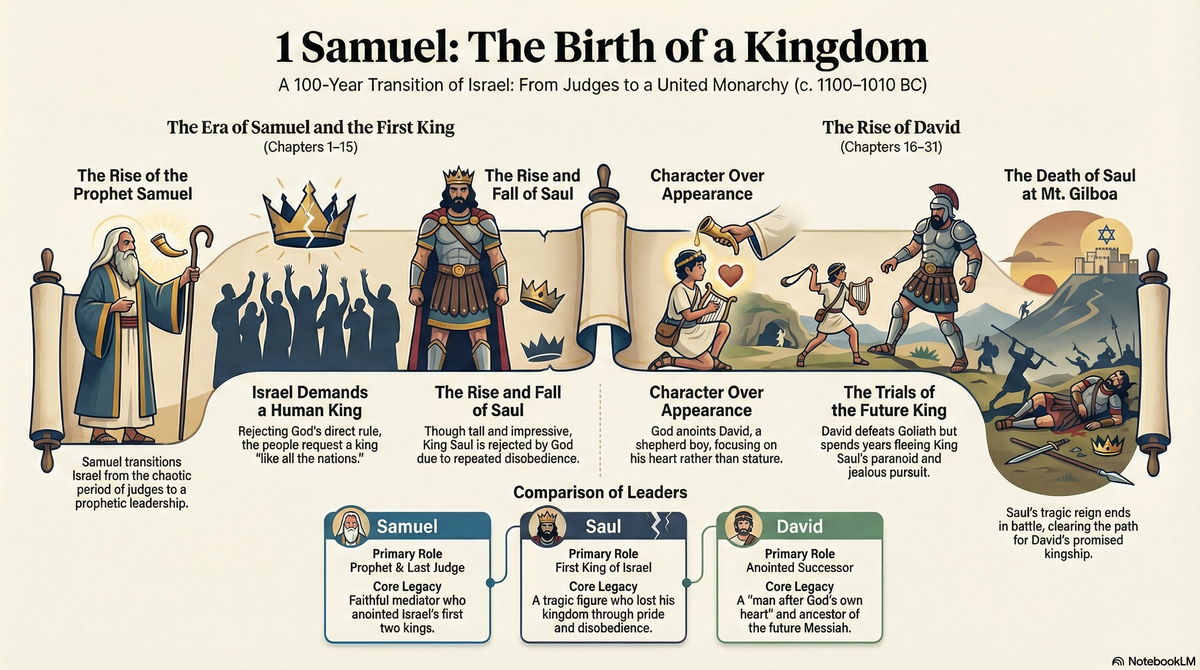
The Book of 1 Samuel (from the New King James Version) bridges the chaotic era of the judges and the establishment of Israel's monarchy. It chronicles the birth and ministry of the prophet Samuel, the rise and tragic fall of Israel's first king Saul, and the dramatic emergence of David as God's chosen king. Traditionally attributed to Samuel (with later contributions possibly from prophets like Gad and Nathan), the book covers roughly 100 years, from the late judges period (c. 1100 BC) to the death of Saul (c. 1010 BC). It divides into three main sections: the rise of Samuel (chs. 1–7), the rise and rejection of Saul (chs. 8–15), and the rise of David amid Saul's decline and pursuit (chs. 16–31). Through personal stories, battles, and divine interventions, 1 Samuel shows how God sovereignly guides Israel's transition from tribal confederacy to united kingdom, selecting leaders based on the heart rather than outward appearance.
Overall Theme:
The overarching theme of 1 Samuel is God's sovereign choice and control over leadership in Israel during the transition from judges to monarchy. The book repeatedly emphasizes that true kingship belongs to the LORD, who raises up and removes leaders according to His will. Hannah's prayer (ch. 2) sets the tone: God reverses human fortunes, exalts the humble, and humbles the proud. Israel's demand for a king "like all the nations" (8:5) reflects rejection of God's direct rule, yet God grants their request while warning of consequences. Saul's reign illustrates the failure of human kingship when it disobeys God; his rejection paves the way for David, the man after God's own heart (13:14). The narrative contrasts obedience (Samuel, David) with disobedience (Saul, Eli's sons), highlighting themes of divine sovereignty, the importance of heartfelt obedience, prayer, and God's faithfulness to His covenant promises despite human failure. It foreshadows the ultimate King in the line of David—Jesus Christ.
Location Settings
Hill country of Ephraim / Ramathaim
Zophim — Hannah and Elkanah's hometown; birthplace of Samuel (ch. 1).
Shiloh — Central religious site where the tabernacle resides; Eli's priestly center, scene of Hannah's prayer, Samuel's upbringing, and the ark's capture (chs. 1–4).
Ramah — Samuel's home and prophetic base; site of his circuit judging Israel (7:15–17).
Mizpah — Place of national assembly, battles against Philistines, and Samuel's leadership (ch. 7).
Gibeah — Saul's hometown and early capital in Benjamin (10:26; 15:34).
Bethlehem — David's family home in Judah (16:1–13).
Various battlefields — Ebenezer (7:12), Michmash (ch. 13–14), Valley of Elah (Goliath, ch. 17), Ziklag (David's Philistine base, chs. 27, 30), Mount Gilboa (Saul's final battle, ch. 31).
Philistine territory — Gath, Ekron, Ashdod (ark's capture and return, chs. 5–6; David's exile, chs. 27–30).The action moves across central and southern Canaan, from northern Shiloh to southern Judah and Philistine plains, reflecting shifting centers of power.
People Involved:
God (the LORD / Yahweh):
Sovereign over history; answers prayer, judges sin, chooses and anoints leaders, and fights for His people.
Samuel:
Last judge and first major prophet; dedicated to God from birth; faithful mediator, anoints Saul and David, confronts kings.
Hannah:
Faithful, barren woman; her prayer and vow lead to Samuel's birth; her song (ch. 2) foreshadows themes of reversal.
Eli:
High priest at Shiloh; godly but fails to restrain corrupt sons; dies after hearing of ark's capture.
Hophni and Phinehas:
Eli's wicked sons; abuse the priesthood; die in battle.
Saul:
First king of Israel; tall, impressive Benjamite; starts well but disobeys God repeatedly; becomes jealous, paranoid, and tragic.
David:
Youngest son of Jesse; shepherd anointed by Samuel; slays Goliath; serves Saul, flees his jealousy; rises as future king.
Jonathan:
Saul's son; brave warrior; forms deep covenant friendship with David; loyal despite his father's hatred.
Supporting figures
- Elkanah — Hannah's husband.
- Peninnah — Elkanah's other wife who provokes Hannah.
- Ahimelech — Priest at Nob who helps David.
- Doeg the Edomite — Saul's servant who slaughters priests.
- Achish — Philistine king of Gath; David seeks refuge with him.
- The Philistines — Primary enemies throughout; capture the ark, oppress Israel, defeat Saul.
Detailed Chapter Summary
Chapters 1–3 – Samuel's birth and call
Hannah, barren and provoked, prays fervently at Shiloh; vows to dedicate her son to God. Samuel born; weaned and given to Eli. Eli's sons corrupt; God pronounces judgment on Eli's house. Young Samuel hears God's voice calling him; receives prophecy against Eli's family.
Chapters 4–7 – The ark captured and returned
Philistines defeat Israel; capture the ark; Eli dies upon hearing the news. Ark brings plagues on Philistines (Ashdod, Gath, Ekron). Philistines return ark to Beth-shemesh, then to Kiriath-jearim. Samuel leads national repentance at Mizpah; Israel defeats Philistines; stone Ebenezer raised (“Thus far the LORD has helped us”).
Chapters 8–12 – Demand for a king and Saul's anointingIsrael demands a king. Samuel warns of king's burdens; God tells him to grant it. Saul (tall Benjamite) seeks lost donkeys, meets Samuel, anointed privately, confirmed publicly at Mizpah. Saul defeats Ammonites at Jabesh-gilead; kingdom renewed at Gilgal.
Chapters 13–15 – Saul's disobedience and rejection
Saul offers unlawful sacrifice (impatient for Samuel); rejected as king. Jonathan's brave attack at Michmash. Saul spares Amalekite king and best spoil against God's command; Samuel confronts him, announces kingdom torn away; Samuel grieves but executes Agag.
Chapters 16–17 – David anointed and slays Goliath
God sends Samuel to Bethlehem; anoints David (youngest son of Jesse). Evil spirit torments Saul; David plays harp for him. David kills Goliath in Valley of Elah with sling and stone; Philistines flee.
Chapters 18–20 – Saul's jealousy and Jonathan's friendship
Saul grows jealous of David's success; tries to kill him. Jonathan covenants with David; warns him of Saul's plots; helps David escape.
Chapters 21–26 – David flees Saul
David flees to Nob (gets bread, sword from Ahimelech); to Gath (feigns madness); to cave of Adullam, then Moab. Saul slaughters priests at Nob. David spares Saul in cave (En Gedi); cuts robe corner. David in wilderness of Paran/Ziph; spares Saul again (sleeping in camp). Nabal's folly; Abigail's wisdom; Nabal dies; David marries Abigail.
Chapters 27–30 – David among Philistines
David lives in Ziklag under Achish. Raids enemies while deceiving Philistines. Amalekites raid Ziklag; David pursues, recovers all. Philistines muster against Israel but send David away.
Chapter 31 – Death of Saul
Philistines defeat Israel at Mount Gilboa; Jonathan and Saul's sons killed; Saul falls on his sword. Philistines desecrate Saul's body; valiant men rescue it.
Closing Prayer:
Sovereign LORD, who raises up leaders and removes them according to Your perfect will, we thank You for the book of 1 Samuel that reveals Your hand guiding Israel through turbulent transition. In Hannah's faithful prayer, Samuel's obedient service, Saul's tragic disobedience, and David's heart for You, we see the contrast between human failure and divine faithfulness. Thank You for choosing not by outward appearance but by the heart, and for preserving a remnant through Your anointed servant David. Forgive us when we, like Israel, demand our own way instead of trusting Your rule. Grant us hearts like David's—to seek You earnestly, obey fully, and trust Your sovereignty in every season. May we look to the greater Son of David, Jesus Christ, our perfect King who reigns forever. To You be glory and praise. Amen.
Try Pastor Mugs App
Your KJV Pocket Companion. Faithful insights, verse clarity, guided prayers—ready whenever you open the Word.
Start Free, no strings ->