The Book of Ecclesiastes: Vanity of Vanities and the Fear of God — Full Book Summary and Key Themes
Comprehensive overview of Ecclesiastes — the Preacher’s search for meaning under the sun, the futility of human endeavors apart from God, the gift of enjoying life, and the conclusion to fear God and keep His commandments.
Ecclesiastes, traditionally known as “The Preacher” or “The Teacher” (from the Hebrew Qoheleth), is a profound work of wisdom literature that wrestles with the meaning of life “under the sun.” Written in a reflective, philosophical style, it explores human experience, work, pleasure, wisdom, wealth, and death from the perspective of one who has observed and tested everything life offers.
Traditionally attributed to Solomon (son of David, king in Jerusalem), though modern scholarship often dates it later (possibly 5th–3rd century BC) and views the attribution as a literary device associating it with Solomonic wisdom.
The book consists of the Preacher’s observations, proverbs, personal experiments, and conclusions, framed by an introduction and epilogue. It spans no specific historical timeline but reflects on universal human experience across a lifetime of searching.
Ecclesiastes divides loosely into: the theme statement and experiments in meaning (chs. 1–2), observations on time, toil, and injustice (chs. 3–5), counsel on living amid uncertainty (chs. 6–11), and the final conclusion (ch. 12).
Overall Theme:
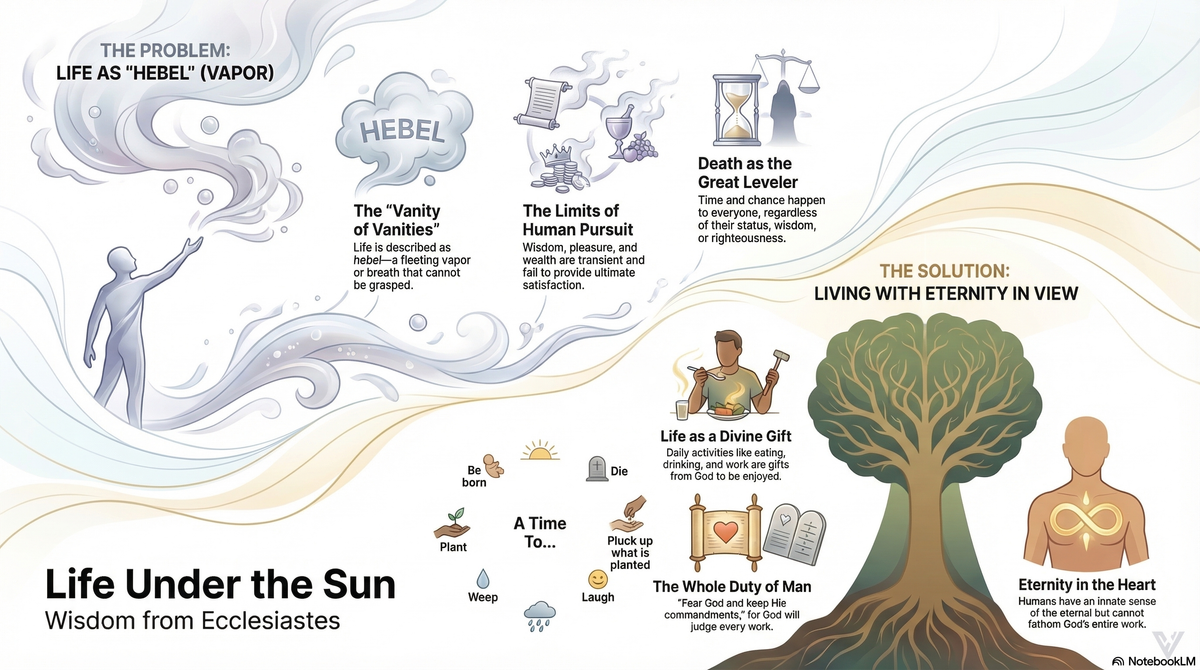
The overarching theme of Ecclesiastes is the futility and vapor-like nature of life “under the sun” apart from God, contrasted with the call to fear God and keep His commandments as the only source of lasting meaning. The repeated refrain “vanity of vanities, all is vanity” (hebel—hebel, meaning “vapor,” “breath,” “meaningless,” “fleeting”) captures the Preacher’s discovery that human endeavors—pleasure, wisdom, work, wealth, power—are ultimately transient, unpredictable, and unable to provide ultimate satisfaction or control over life’s outcomes.
Death levels everyone; time and chance happen to all; injustice and oppression persist. Yet this is not despairing nihilism: the book affirms that life is a gift from God to be enjoyed gratefully (eating, drinking, work, marriage, youth), and the proper response to life’s enigmas is to fear God, obey His commands, and live with eternity in view.
Ecclesiastes confronts secular humanism’s search for meaning within creation alone and points to the necessity of a God-centered perspective: only in relationship with the Creator who stands above time and death can life have enduring purpose. It foreshadows the gospel by exposing the limits of this fallen world and the need for a Redeemer who conquers vanity and death.
Location Settings:
Ecclesiastes is not a narrative with specific geographical progression but a reflective discourse set in the mind and experience of the Preacher, traditionally identified as Solomon in Jerusalem.
- Jerusalem — Implicit as the royal capital where the “son of David, king in Jerusalem” (1:1) observes life from the palace, courts, gardens, and public spaces. References to kings, courts, oppression under rulers, and wisdom in the city assume a royal, urban setting.
- “Under the sun” / “under heaven” — The book’s primary “location” is the observable, temporal world of human experience—fields, vineyards, marketplaces, courts of justice, workplaces, homes—anywhere people live, labor, love, suffer, and die. No specific journeys or locations dominate; the focus is existential and universal rather than geographical.
- Gardens, vineyards, houses, parks — Mentioned in the Preacher’s personal experiments (2:4–6), evoking Solomon’s luxurious estates and building projects (cf. 1 Kings 7; Song of Solomon).The setting is deliberately broad and timeless, emphasizing that the Preacher’s observations apply to all humanity in every place and era.
People Involved
The Preacher (Qoheleth):
The central voice; “son of David, king in Jerusalem” (1:1); traditionally Solomon. A wise observer who has pursued meaning through every avenue—wisdom, pleasure, work, wealth—and concludes all is vanity apart from God.
God (the Elohim / Creator / Maker):
Sovereign over time, seasons, life, and death; the One who gives life as a gift, judges every work, and is to be feared and obeyed. He stands outside the “under the sun” perspective, giving meaning beyond human grasp.
Humanity (the sons of men / everyone):
All people—kings, wise, fools, rich, poor, righteous, wicked—share the same fate under the sun: toil, uncertainty, death. The Preacher speaks for and to every person searching for purpose.
The wise and the fool:
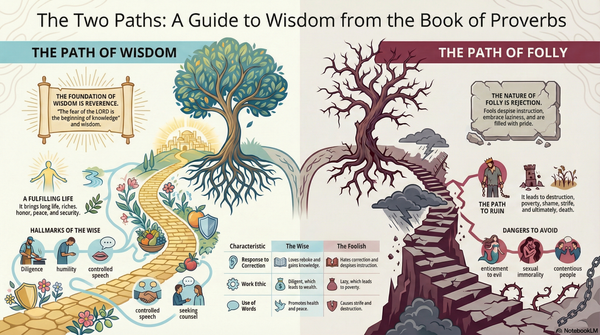
Contrasted throughout; wisdom excels folly as light darkness, yet both die and are forgotten.
The oppressor and the oppressed:
Illustrate injustice and the tears of the powerless with no comforter (4:1).
The worker / laborer:
Toils endlessly, often leaving gain to others or facing misfortune.
The king / rulers:
Powerful yet often foolish or oppressive; the Preacher reflects on royal life from experience.
The young and the old:
Youth urged to enjoy life before age and death come (ch. 12); old age depicted poignantly as decline.
No extended cast of named individuals appears; the focus is on universal types and the Preacher’s own quest.
Detailed Chapter Summary:
Chapters 1–2 – The theme and experiments
“All is vanity”; cycles of nature and generations go on endlessly. The Preacher tests wisdom (more sorrow), pleasure (empty), great works (vineyards, gardens, wealth)—all vanity; nothing new under the sun; death comes to all.
Chapters 3–5 – A time for everything; observations on life
Famous poem: “To everything there is a season” (3:1–8). God has made everything beautiful in its time; eternity in human hearts; yet cannot fathom God’s work. Injustice, envy, loneliness, oppression observed; better a poor wise youth than old foolish king. Fear God; vows and words before God matter; wealth brings anxiety.
Chapters 6–8 – Limits of wealth, wisdom, and power
Man cannot enjoy what he has; better miscarriage than unfulfilled life. Enjoyment is God’s gift. Wisdom better than strength, yet one sinner destroys much good. Obey the king; no one righteous; do not be overly righteous or wise. Enjoy life with wife; God’s ways inscrutable.
Chapters 9–11 – Living amid uncertainty
Death comes to all; enjoy life as God’s gift—eat, drink, rejoice with wife. Time and chance happen; wisdom better yet often unrewarded. Wisdom of fools; invest widely; youth enjoy but know God will judge.
Chapter 12 – Conclusion and epilogue
Remember Creator in youth before old age; poetic description of aging and death. Fear God and keep His commandments—this is the whole duty of man. All works judged; final note on the Preacher’s words.
Closing Prayer:
Eternal God, Creator and Judge of all, who has set eternity in our hearts yet kept us from grasping the full scope of Your works, we thank You for the book of Ecclesiastes that honestly confronts the vanity of life under the sun. In the Preacher’s search and sobering conclusions, we see the emptiness of pursuing meaning apart from You—pleasure fades, wisdom is limited, wealth passes to others, and death comes to all. Yet we praise You that You are not bound by time or chance; You give life as a gift to be enjoyed gratefully, and You call us to fear You and keep Your commandments as the path to true purpose. Thank You for the greater Teacher, Jesus Christ, who lived perfectly under the sun, died to redeem us from futility, and rose to give us eternal life beyond the vapor of this world. Grant us grace to number our days, rejoice in Your gifts, and live with eternity in view until we see You face to face and every question finds its answer in You. To You be glory forever. Amen.