The Book of Esther: Providence, Courage, and Deliverance — Full Book Summary and Key Themes
Comprehensive overview of Esther — a Jewish orphan becomes queen of Persia, risks her life to thwart Haman’s genocidal plot against the Jews, and secures deliverance through providence, courage, and reversal, leading to the establishment of Purim.
Summary
The Book of Esther is a dramatic historical narrative set in the Persian Empire during the reign of King Ahasuerus (Xerxes I, c. 486–465 BC). It tells the story of how God providentially delivers the Jewish people from a genocidal plot orchestrated by the arrogant official Haman. The book introduces Esther, a young Jewish orphan raised by her cousin Mordecai, who becomes queen of Persia and, with Mordecai’s guidance, risks her life to intercede for her people.
Traditionally attributed to Mordecai or an anonymous post-exilic author (possibly Ezra or a contemporary), Esther covers events over approximately a decade, with the main action unfolding in one intense year (c. 474–473 BC). Unlike most biblical books, it never explicitly mentions God, prayer, or the Law, yet His sovereign providence is unmistakably at work behind every “coincidence.”
The book divides into two main sections: the rise of Esther and the threat of annihilation (chs. 1–4), and the deliverance through courage, fasting, and reversal of fortune (chs. 5–10). Esther is read annually at the Jewish festival of Purim, celebrating God’s hidden but powerful protection of His people.
Overall Theme:
The overarching theme of Esther is God’s hidden but sovereign providence in preserving His people against overwhelming odds, even when His name is not spoken and circumstances seem hopeless. The book demonstrates that God works through ordinary people, “chance” events, and ironic reversals to accomplish His purposes.
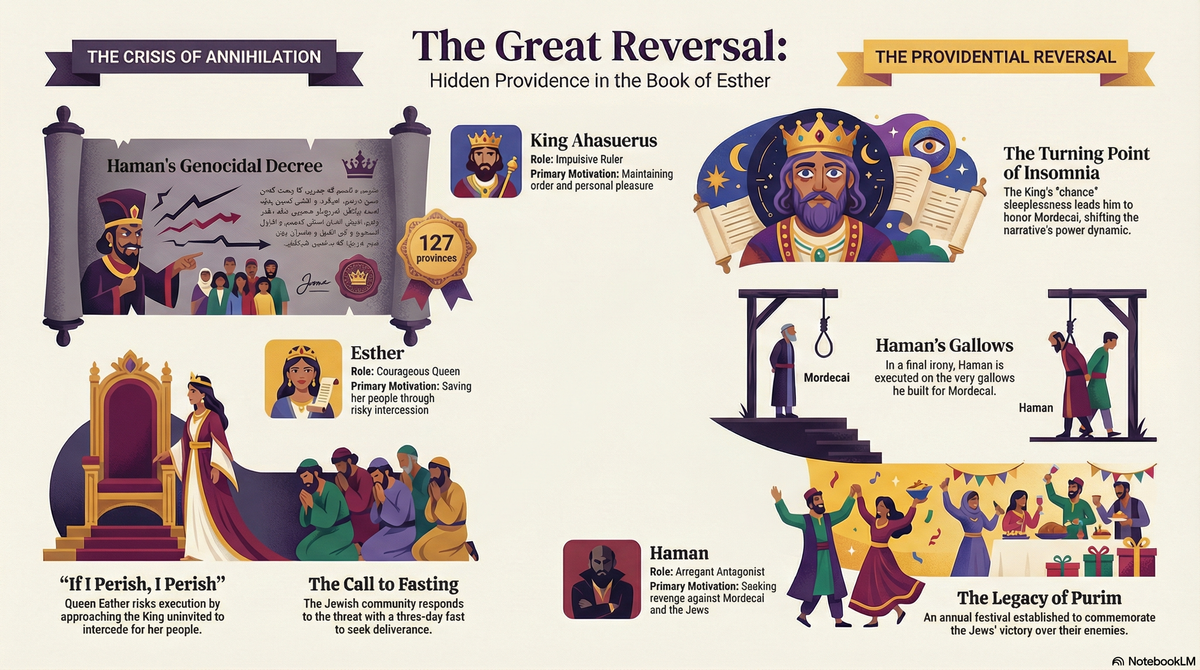
Key elements include the reversal motif (the proud are humbled, the humble exalted), the courage of faith in crisis (Esther’s famous “if I perish, I perish”), and the responsibility of God’s people to act decisively when providence opens a door. Though God is not named, His presence permeates the narrative: the timing of Vashti’s fall, Esther’s selection as queen, Mordecai’s discovery of the assassination plot, the king’s insomnia leading him to read the chronicles, and Haman’s gallows becoming his own execution site.
Esther shows that even in a pagan empire far from Jerusalem, God remains faithful to His covenant promises to preserve a remnant. The absence of overt religious language highlights providence operating in the secular sphere, reassuring post-exilic Jews (and believers today) that God is at work even when He seems silent or absent. The book foreshadows the ultimate deliverance through Christ, who reverses the curse of sin and death.
Location Settings
Susa (Shushan) — The primary and almost exclusive setting; the winter capital of the Persian Empire in modern southwestern Iran.
- The royal palace in Susa is the central stage: the lavish banquet hall where Vashti refuses the king (ch. 1), the women’s quarters where Esther is prepared and crowned (ch. 2), the king’s throne room and inner court where Esther approaches uninvited (ch. 5), the king’s bedchamber where he cannot sleep and reads the chronicles (ch. 6), and the palace courtyard and garden where banquets occur (chs. 5, 7).
- The citadel of Susa — The fortified administrative center; decrees are issued from here, and the gallows (50 cubits high) is erected near the palace (chs. 5, 7).
- The king’s gate — Where Mordecai sits daily, overhears the plot against the king, and later receives honor (chs. 2, 6).
- The provinces throughout the 127 provinces from India to Ethiopia — The edict of destruction is sent to every province; the Jews defend themselves across the empire on the 13th of Adar (ch. 9).
No scenes occur in Jerusalem or the land of Judah; the story unfolds entirely in the diaspora, emphasizing God’s care for His people scattered among the nations.
People Involved
God (the LORD / Yahweh):
Never named explicitly, yet sovereignly orchestrates every event—Vashti’s removal, Esther’s rise, Mordecai’s discovery, the king’s sleepless night—to deliver His people.
Ahasuerus (Xerxes I):
King of Persia; impulsive, lavish, easily influenced; issues irreversible decrees but ultimately favors the Jews.
Esther (Hadassah):
Jewish orphan, cousin of Mordecai; chosen as queen; initially passive but grows into courageous intercessor; risks her life to save her people.
Mordecai:
Esther’s cousin and guardian; devout Jew who refuses to bow to Haman; discovers assassination plot; becomes second to the king; leads Jewish resistance.
Haman the Agagite:
Prime minister; descendant of Agag (Amalekite enemy of Israel); arrogant, hates Mordecai and plots genocide against all Jews; builds gallows; ultimately hanged on his own device.
Vashti:
Queen deposed for refusing the king’s command; her fall creates the vacancy for Esther.
Supporting figures:
- Memucan, the wise men, and advisors — Counsel the king on Vashti’s punishment and later on Haman’s edict.
- Hegai — Chief eunuch of the harem; favors Esther.
- Bigthan and Teresh — Eunuchs who plot to assassinate the king; Mordecai exposes them.
- Zeresh — Haman’s wife; advises him to build the gallows.
- The Jews throughout the provinces — Fast, mourn, and later rejoice and defend themselves.
- The king’s scribes and couriers — Issue and deliver the contradictory decrees.
Detailed Chapter Summary:
Chapter 1 – Vashti deposed
Ahasuerus hosts lavish banquets for 180 days; on the seventh day, he commands Vashti to display her beauty; she refuses; advisors recommend deposing her to preserve male authority.
Chapter 2 – Esther becomes queen
Search for a new queen; Esther (Hadassah) is taken into the harem; favored by Hegai; Mordecai instructs her to conceal her Jewish identity. Esther wins the king’s favor and is crowned. Mordecai uncovers assassination plot; Esther reports it; deed recorded.
Chapters 3–4 – Haman’s plot
Haman promoted; all must bow to him; Mordecai refuses. Haman enraged; casts lots (Pur) to destroy all Jews; persuades king to issue edict of annihilation on 13th of Adar. Mordecai mourns; urges Esther to intercede. Esther requests three-day fast; says, “If I perish, I perish.”
Chapters 5–7 – Reversal begins
Esther invites king and Haman to banquet; requests second banquet. Haman boasts but rages at Mordecai. Zeresh advises building gallows. King sleepless; reads chronicles; honors Mordecai publicly. Haman humiliated; at second banquet Esther reveals plot; king enraged; Haman hanged on his own gallows.
Chapters 8–9 – Deliverance and Purim
Esther and Mordecai receive Haman’s estate; new edict allows Jews to defend themselves. Jews slay enemies on 13th of Adar; in Susa, fighting continues to 14th. Mordecai establishes Purim: days of feasting, gift-giving, and charity to commemorate deliverance.
Chapter 10 – Mordecai’s greatness
Mordecai second to the king; greatness recorded in Persian chronicles.
Closing Prayer:
Sovereign and unseen God, who works behind every event and turns the hearts of kings like channels of water, we thank You for the book of Esther that reveals Your mighty providence even when Your name is unspoken. In Esther’s courage, Mordecai’s faithfulness, and the dramatic reversal of Haman’s evil plot, we see Your hand preserving Your people against impossible odds. Thank You for showing that no decree of man can thwart Your covenant promises, and that You deliver those who trust You, even in exile and danger.
Forgive us when we forget Your presence in difficult seasons or fail to act when You open doors. Grant us Esther’s willingness to risk all for Your people, Mordecai’s integrity in refusing compromise, and the joy of celebrating Your deliverance. Above all, we praise You for the greater Deliverer, Jesus Christ, who reversed the curse of sin on the cross and secured eternal salvation for all who trust Him. May we live boldly for Your glory until every enemy is defeated and Your kingdom comes in fullness. To You be glory forever. Amen.