The Book of Ezra: Return from Exile, Temple Rebuilding, and Covenant Renewal — Full Book Summary and Key Themes
Comprehensive overview of Ezra — Cyrus's decree and the first return under Zerubbabel to rebuild the temple, opposition overcome, and Ezra's later return to teach the Law and reform intermarriages, emphasizing God's restoration and call to holiness.
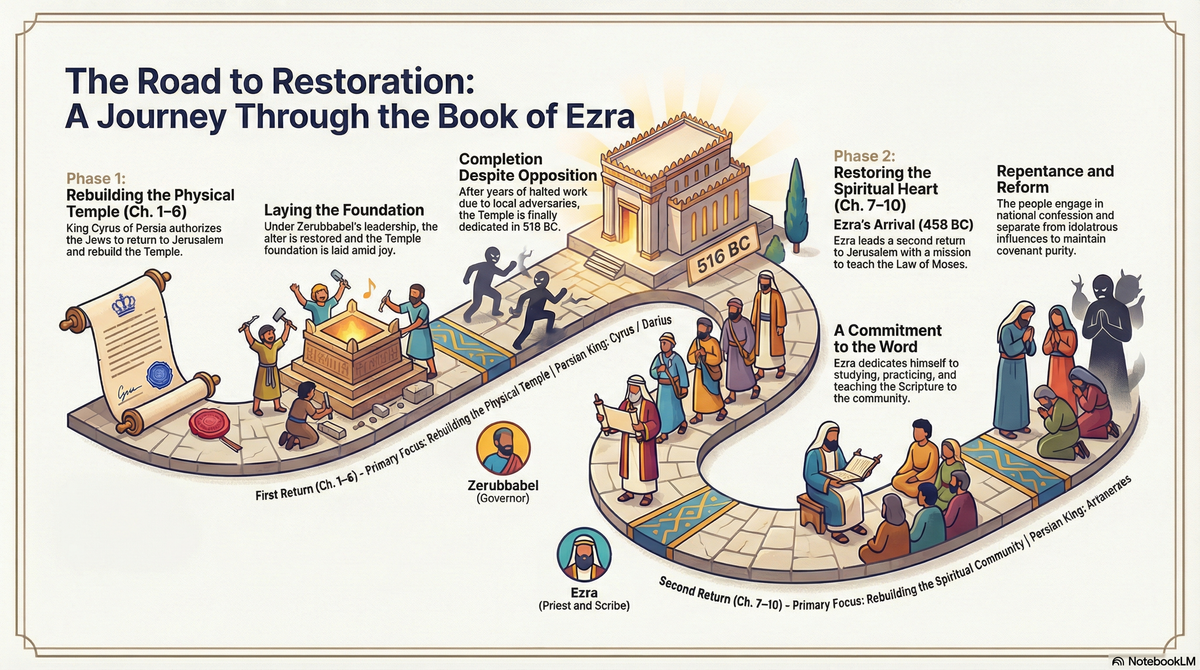
The Book of Ezra records the restoration of the Jewish people after the Babylonian exile, focusing on the first two returns from Babylon to Jerusalem and the rebuilding of the temple and community life.
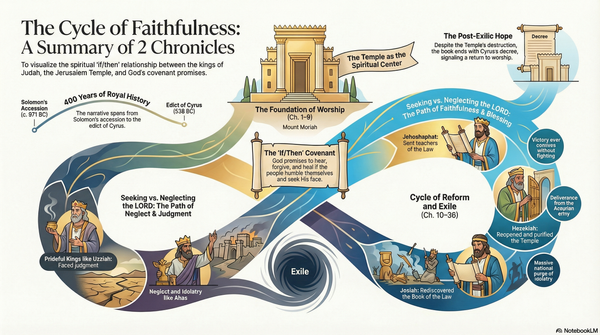
Traditionally attributed to Ezra himself (the priest and scribe) or a chronicler closely associated with him, the book forms a continuation of 2 Chronicles and is closely linked with Nehemiah (originally one work in Hebrew manuscripts).
Ezra covers events spanning about 80 years (c. 538–458 BC), from Cyrus's decree allowing return (538 BC) to Ezra's arrival and reforms (458 BC). The book divides into two main sections: the first return under Zerubbabel and the rebuilding of the temple (chs. 1–6), and the second return under Ezra with spiritual and moral renewal (chs. 7–10).
Written to encourage the post-exilic community, Ezra emphasizes God's faithfulness in fulfilling prophecy (e.g., Jeremiah's 70 years), the importance of the temple as the center of worship, adherence to the Law of Moses, and separation from surrounding peoples to maintain covenant purity.
Overall Theme:
The overarching theme of Ezra is God's sovereign restoration of His people and the renewal of covenant worship centered on the temple and obedience to His Law. After judgment through exile, God stirs the heart of a pagan king (Cyrus) to fulfill His word, enabling the return, temple rebuilding, and community reformation. The book highlights divine providence—God moves kings, provides resources, protects against opposition, and raises leaders like Zerubbabel, Joshua, and Ezra to guide His people.
Key emphases include returning to proper worship (temple reconstruction despite opposition), joy in God's presence, and the necessity of holiness through separation from idolatry and mixed marriages. Ezra portrays restoration not as mere political recovery but as spiritual renewal: rebuilding the physical house of God and the spiritual house of the people through repentance, confession, and commitment to the Law.
The book foreshadows the greater restoration in Christ, the true temple (John 2:19–21), who brings ultimate purification and access to God's presence.
Location Settings:
Babylon / Persia (modern Iraq and Iran) — Starting point for both returns.
- Cyrus issues his decree from Persia (ch. 1).
- Ezra travels from Babylon to Jerusalem under Artaxerxes (ch. 7–8).
Jerusalem and Judah — Primary setting for most of the narrative.
- The temple site (on Mount Moriah) — Central focus: foundations laid (ch. 3), work halted by opposition (ch. 4), resumed under Darius and completed/dedicated (chs. 5–6).
- The returned exiles settle in their ancestral towns throughout Judah (chs. 2, 8).
- Jerusalem's walls and gates — Mentioned briefly as still in ruins (foreshadowing Nehemiah).
- The river Ahava — Gathering point for Ezra's caravan before departure (ch. 8).
Samaria and surrounding regions — Source of opposition: "adversaries of Judah and Benjamin" (Samaritan peoples) hinder temple work (chs. 4–5).The geography contrasts the imperial centers of Persia with the restored but vulnerable community in Jerusalem, symbolizing God's people reestablished in the Promised Land under foreign rule.
People Involved
God (the LORD / Yahweh):
Sovereign over empires; stirs Cyrus's spirit, fulfills prophecy, protects His people, and inspires leaders to rebuild and reform.
Cyrus (king of Persia):
Issues decree allowing return and temple rebuilding; returns temple vessels.
Zerubbabel (governor, descendant of David):
Leads first return; oversees temple foundation and rebuilding; grandson of Jehoiachin.
Joshua (Jeshua) (high priest):
Son of Jozadak; partners with Zerubbabel in rebuilding altar and temple.
Ezra (priest and scribe):
Central figure in second half; expert in the Law of Moses; leads second return, teaches Scripture, confronts intermarriage, leads confession and covenant renewal.
Sheshbazzar:
Prince of Judah; first leader mentioned under Cyrus; possibly early governor or another name for Zerubbabel.
Darius (king of Persia):
Confirms Cyrus's decree; orders temple completion and support.
Artaxerxes (king of Persia):
Authorizes Ezra's mission; provides resources and protection.
The adversaries / people of the land:
Descendants of Assyrian settlers in Samaria; oppose rebuilding, write accusations to Persian kings.
Supporting figures / groups:
- The heads of fathers' houses and returned exiles (detailed list in ch. 2 and 8).
- Tattenai (governor beyond the River); investigates temple work but obeys Darius.
- Haggai and Zechariah (prophets): Encourage rebuilding (mentioned in ch. 5).
- The priests, Levites, singers, gatekeepers, temple servants — Return and resume duties.
Detailed Chapter Summary:
Chapters 1–2 – Cyrus's decree and first returnCyrus proclaims Jews may return and rebuild temple; returns vessels. List of returnees under Zerubbabel (42,360 people plus servants).
Chapter 3 – Altar rebuilt and temple foundation laidAltar restored; sacrifices resume; foundation laid amid joy and weeping.
Chapter 4 – Opposition halts workAdversaries offer help but are refused; write to Artaxerxes; work stops until Darius's second year.
Chapters 5–6 – Rebuilding resumed and completedHaggai and Zechariah prophesy; Tattenai investigates. Darius searches archives, confirms Cyrus's decree, orders support. Temple finished (516 BC); dedicated with joy; Passover kept.
Chapters 7–8 – Ezra's returnArtaxerxes authorizes Ezra; grants silver, gold, vessels. Ezra gathers company at Ahava; fasts, prays for protection; arrives safely in Jerusalem.
Chapters 9–10 – Ezra's reformsEzra learns of intermarriages with foreign peoples; tears garments, prays confession. People assemble; weep and agree to put away foreign wives. Commission investigates; list of offenders.
Closing Prayer:
Gracious and sovereign God, who stirred the heart of Cyrus to fulfill Your word and brought Your people back from exile, we thank You for the book of Ezra that reveals Your faithfulness in restoration. In the rebuilding of the temple, the return of Your people, and Ezra's zeal for Your Law, we see Your desire for a holy community centered on worship and obedience.
Thank You for preserving the Davidic line, providing for Your house, and protecting Your remnant despite opposition. Forgive us when we compromise with the world or neglect Your presence. Raise up in us the same heart as Ezra—to study, practice, and teach Your Word, to repent deeply, and to pursue holiness.
Above all, we praise You for the greater Temple, Jesus Christ, who was raised in three days and now dwells with us by Your Spirit, until the day we see the New Jerusalem descending with no need of temple, for You and the Lamb are its light. To You be glory forever. Amen.
Try Pastor Mugs App
Your KJV Pocket Companion. Faithful insights, verse clarity, guided prayers—ready whenever you open the Word.
Start Free, no strings ->