The Book of Job: Suffering, Sovereignty, and Trusting God — Full Book Summary and Key Themes
Comprehensive overview of Job — the righteous man tested through devastating loss, debates with friends over innocent suffering, God’s majestic speeches from the whirlwind, Job’s humble repentance, and ultimate restoration, exploring the mystery of divine justice and human faith.

Summary
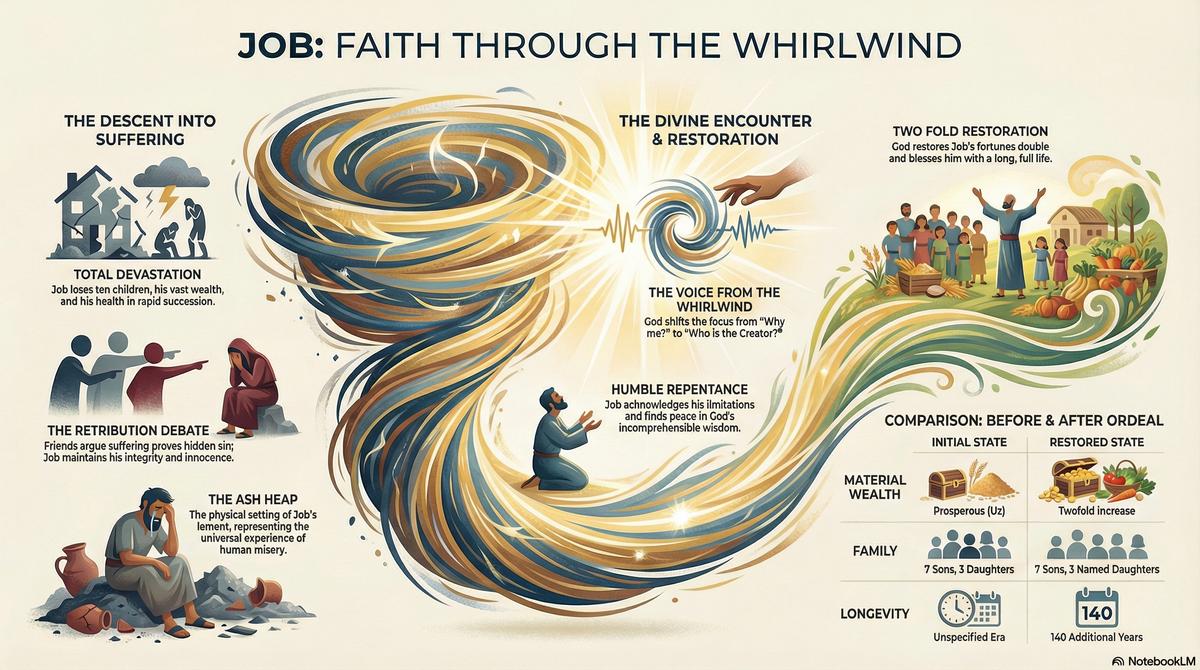
The Book of Job is a profound poetic and dramatic exploration of suffering, righteousness, divine justice, and human limitation in understanding God’s ways. Set in the patriarchal era (likely pre-Moses), it tells the story of Job, a blameless and upright man of great wealth and piety in the land of Uz, whose life is suddenly devastated by catastrophic losses orchestrated through a heavenly dialogue between God and Satan. Job loses his children, wealth, and health in rapid succession, yet refuses to curse God. Three friends (later a fourth) arrive to comfort him but instead engage in lengthy cycles of debate, insisting his suffering must be punishment for hidden sin. Job maintains his integrity, pleads his case, and longs for a mediator with God.
Finally, God speaks from a whirlwind, not explaining Job’s suffering but revealing His sovereign power and wisdom over creation. Job repents in dust and ashes, God rebukes the friends, restores Job’s fortunes twofold, and blesses him with new children and a long life. Traditionally attributed to Job himself, Moses, or an anonymous author (possibly post-exilic), the book is structured as prose prologue and epilogue framing a central poetic dialogue. It covers an unspecified period but focuses on Job’s ordeal and restoration.
Overall Theme:
The overarching theme of Job is the mystery of innocent suffering and the sovereignty of God, who is worthy of worship even when His ways are incomprehensible to finite humans. The book rejects simplistic retribution theology (suffering always equals punishment for sin) and challenges the assumption that God’s justice must be immediately understandable or fair by human standards. Job’s steadfast refusal to curse God despite unimaginable loss demonstrates genuine piety that endures beyond blessings.
The friends represent conventional wisdom that ties suffering directly to personal guilt; their arguments, though eloquent, prove inadequate. God’s speeches from the whirlwind shift focus from “why me?” to “who is God?”—emphasizing His incomparable power, wisdom, and governance over a vast, untamed creation. Job learns humble awe rather than full explanation.
The restoration epilogue affirms God’s ultimate goodness and justice, yet the book leaves much unanswered, teaching that faith trusts God’s character amid mystery. Job anticipates the gospel: innocent suffering finds ultimate meaning in Christ, the truly righteous Sufferer who intercedes and restores.
Location Settings:
The land of Uz — Job’s homeland; a region associated with Edom (east of Palestine, possibly northern Arabia or southern Transjordan). It is portrayed as fertile and prosperous, with pastoral and agricultural wealth (sheep, camels, oxen, donkeys).
- Job’s household and estates are the initial setting of blessing and tragedy (chs. 1–2).
- The ash heap outside the city where Job sits in mourning and affliction (2:8; 19:17).
The heavenly council / divine assembly — The prologue’s cosmic courtroom where God and “the sons of God” (including Satan) convene (1:6; 2:1). Not a physical location but a transcendent realm where divine decrees are made.
No specific cities or journeys — Unlike patriarchal narratives, Job has minimal geography. The action is largely stationary: Job’s home, then his place of lament on the ash heap. Friends travel from their regions to comfort him (Eliphaz from Teman, Bildad from Shuah, Zophar from Naamath—Edomite/Arabian locales). The whirlwind scene occurs in the same place of suffering. The setting is deliberately universal and timeless, focusing on existential and theological questions rather than historical geography.
People Involved:
God (the LORD / Yahweh):
Sovereign Creator and Judge; permits Job’s testing but sets limits; speaks from the whirlwind, rebuking human presumption while affirming His wisdom and power; restores Job.
Job:
Central figure; blameless, upright, God-fearing man of immense wealth; loses everything yet holds integrity; questions God passionately but never curses Him; humbled and restored.
Satan (the Adversary):
Accuser in the heavenly court; challenges Job’s motives, claiming his piety is transactional; permitted to afflict Job but not kill him.
Job’s three friends:
- Eliphaz the Temanite — Speaks first; appeals to experience and visions; insists suffering proves sin.
- Bildad the Shuhite — Appeals to tradition and ancestral wisdom; suffering is divine justice.
- Zophar the Naamathite — Most harsh; accuses Job of secret wickedness and calls for repentance.All three are sincere but wrong; God rebukes them for misrepresenting Him.
Elihu son of Barachel the Buzite:
Younger observer; intervenes in anger at both Job and friends; argues suffering can be disciplinary and educational; defends God’s justice; speeches prepare for God’s appearance.
Job’s wife:
Brief but poignant role; urges Job to “curse God and die” (2:9); disappears after this.
Job’s children and servants:
Seven sons and three daughters initially; killed in calamities. New children born in restoration (seven sons, three daughters named Jemimah, Keziah, Keren-happuch).
Supporting figures:
- The Sabeans, Chaldeans, fire from heaven, great wind — Agents of Job’s losses.
- The “sons of God” — Heavenly beings present in the prologue.
Detailed Chapter Summary:
Chapters 1–2 – Prologue: Job’s blessing and testing
Job described as blameless; fears God, shuns evil. Heavenly council; Satan challenges Job’s piety. God permits testing. Job loses livestock, servants, children; tears robe, shaves head, worships. Second council; Satan afflicts Job with sores. Job sits in ashes; wife urges cursing God; Job rebukes her.
Chapters 3–31 – Dialogue cycles (three rounds)
Job curses his birth day (ch. 3). Friends speak in turn: Eliphaz (4–5), Bildad (8), Zophar (11); Job responds each time (6–7, 9–10, 12–14). Second cycle (15–21); third cycle (22–31, Zophar’s speech missing). Friends insist sin causes suffering; Job maintains innocence, cries for justice, longs for mediator/redeemer (9:33; 16:19; 19:25).
Chapters 32–37 – Elihu’s speeches
Young Elihu angry at older men’s failure; defends God’s justice, sovereignty, use of suffering for discipline; describes God’s greatness in nature; prepares for God’s voice.
Chapters 38–41 – God speaks from whirlwind
God questions Job: “Where were you when I laid the foundation of the earth?” (38:4). Describes creation, sea, stars, animals (Behemoth, Leviathan). Reveals divine wisdom and power over chaos; no direct answer to Job’s “why.”
Chapter 42 – Job’s repentance and restoration
Job humbles himself: “I have uttered what I did not understand” (42:3). God rebukes friends; Job prays for them. God restores Job twofold: new livestock, seven sons, three daughters; lives 140 more years; sees grandchildren to fourth generation; dies old and full of days.
Closing Prayer:
Almighty and incomprehensible God, who reigns over creation in unsearchable wisdom and power, we thank You for the book of Job that honestly wrestles with the mystery of suffering and the limits of human understanding. In Job’s steadfast faith amid crushing loss, in his bold questions, and in his humble repentance before Your majesty, we see the path of true piety that clings to You even when answers are withheld.
Forgive us when we demand explanations or assume suffering always reveals sin. Thank You for not abandoning Job in silence but speaking in the whirlwind, revealing Yourself as the sovereign Creator worthy of awe and trust. Above all, we praise You for the greater Righteous Sufferer, Jesus Christ, who endured the ultimate affliction not for His own sin but ours, who cried out in forsakenness yet trusted You fully, and who now intercedes as our Advocate and Redeemer. Grant us grace to fear You, trust Your goodness, and hold fast in every trial until we see You face to face and every tear is wiped away in Your eternal kingdom. To You be glory forever. Amen.