The Book of Joshua: Conquest and Inheritance of the Promised Land
Complete overview of Joshua’s leadership in Israel’s conquest of Canaan, the fall of Jericho, division of the land among the tribes, covenant renewal at Shechem, and calls to exclusive devotion to the LORD.
Summary
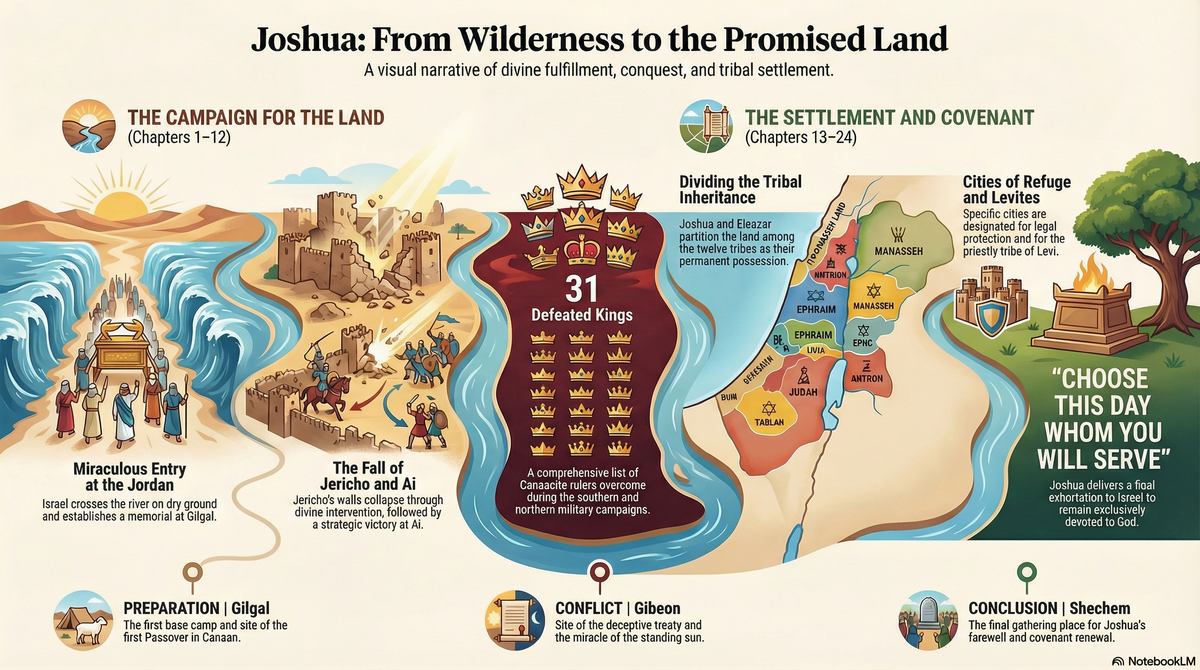
The Book of Joshua narrates the triumphant entry of the Israelites into the Promised Land after the wilderness wanderings, the miraculous conquest of key Canaanite strongholds, the defeat of coalitions of kings, and the orderly division of the land among the twelve tribes as their inheritance. Traditionally attributed to Joshua himself (with possible later editorial additions), the book serves as the natural sequel to Deuteronomy, showing the fulfillment of God’s covenant promises to Abraham, Isaac, and Jacob regarding the land of Canaan. It covers roughly twenty-five to thirty years, from the crossing of the Jordan (c. 1406 BC in traditional dating) to Joshua’s farewell and death at 110 years old. The book divides into three main sections: the conquest of the land (chs. 1–12), the allotment of tribal territories (chs. 13–22), and Joshua’s final exhortations and covenant renewal (chs. 23–24).
Overall Theme:
The overarching theme of Joshua is God’s sovereign faithfulness in giving Israel the Promised Land through obedient faith and decisive action. The LORD repeatedly assures Joshua, “Be strong and of good courage” (1:6, 7, 9, 18), promising His presence as He was with Moses. Every major victory—Jericho, Ai (after dealing with sin), the southern and northern campaigns—comes through God’s direct intervention (falling walls, hailstones, extended daylight). The book emphasizes that the land is God’s gift, not Israel’s achievement; success depends on obedience to the law of Moses and exclusive devotion to Yahweh alone. Yet warnings abound: Achan’s sin brings defeat, the Gibeonites’ deception exposes the danger of making treaties without consulting God, and Joshua’s final speeches foresee future unfaithfulness leading to loss of the land. Joshua portrays the conquest as holy war (herem—total devotion to destruction of idolatrous peoples and their altars), underscoring God’s judgment on Canaanite wickedness and Israel’s calling to be a holy nation set apart for Him.
Location Settings:
The land of Canaan (west of the Jordan) — Primary setting for the entire book.
- Plains of Moab / east of the Jordan — Opening scene; Israel encamped here as Joshua receives his commission (ch. 1).
- Jordan River — Miraculous crossing on dry ground (ch. 3–4); memorial stones set up at Gilgal.
- Gilgal — First base camp in Canaan; site of circumcision, Passover, manna ceasing, and commander of the LORD’s army appearance (chs. 4–5).
- Jericho — First major conquest; walls fall (ch. 6).
- Ai — Initial defeat due to sin, then victory (ch. 7–8).
- Gibeon — Deceptive treaty made; site of sun standing still during battle (ch. 10).
- Southern campaign — Conquest of cities in the Shephelah and Negev (Makkedah, Libnah, Lachish, Eglon, Hebron, Debir).
- Northern campaign — Defeat of coalition at waters of Merom (ch. 11).
- Tribal allotments — Detailed boundaries and cities for Judah, Ephraim, Manasseh, Benjamin, Simeon, Zebulun, Issachar, Asher, Naphtali, Dan; special portions for Caleb (Hebron), Joshua (Timnath-serah), and Levites (scattered cities).The narrative moves from east to west across the Jordan, then southward and northward in sweeping campaigns, ending with Israel settled throughout the land “from Dan to Beersheba.”
People Involved:
God (the LORD / Yahweh):
The divine warrior and promise-keeper; fights for Israel, gives victory, appears as commander of the army of the LORD (5:13–15).
Joshua:
Moses’ successor; faithful spy from earlier generation; strong, courageous leader; military commander, covenant mediator, and elder who charges Israel to serve the LORD.
Caleb:
Faithful spy (from Judah); at 85 years old receives Hebron as inheritance for his unwavering faith.
Rahab:
Canaanite prostitute in Jericho; hides Israelite spies, confesses faith in Israel’s God, spared with her family; becomes ancestor in Messiah’s line.
The two spies (sent to Jericho):
Unnamed; protected by Rahab.
Achan:
From tribe of Judah; steals devoted things from Jericho; his sin causes defeat at Ai; he and his household are stoned.
The Gibeonites:
Hivites who deceive Israel into a treaty by pretending to be from far away; become woodcutters and water carriers.
Eleazar the priest and Phinehas:
Eleazar assists in land division; Phinehas leads delegation to confront eastern tribes over altar misunderstanding.
The eastern tribes (Reuben, Gad, half-Manasseh):
Receive land east of Jordan (already allotted by Moses); build witness altar to affirm unity.
Various Canaanite kings:
Kings of Jericho, Ai, Jerusalem (Adoni-zedek), and northern coalition leaders; all defeated.
The Israelites:
The twelve tribes; conquer, settle, and receive inheritance; charged to remain faithful.
Detailed Chapter Summary:
Chapters 1–5 – Preparation and entry into Canaan
God commissions Joshua; spies sent to Jericho; Rahab protects them and is promised deliverance. Jordan crossed on dry ground; memorial stones; circumcision renewed at Gilgal; Passover kept; manna ceases; commander of the LORD’s army appears.
Chapters 6–8 – Conquest of Jericho and Ai
Jericho’s walls fall after seven days of marching; city devoted to destruction; Rahab spared. Achan’s sin causes defeat at Ai; sin judged; Ai taken by ambush.
Chapters 9–10 – Gibeonite treaty and southern campaign
Gibeonites deceive Israel into covenant; become servants. Five Amorite kings attack Gibeon; Joshua defeats them; sun and moon stand still; kings executed at Makkedah.
Chapter 11 – Northern campaign
Northern kings unite; defeated at waters of Merom; Hazor burned; summary of conquered kings.
Chapter 12 – List of defeated kings
Thirty-one kings listed from east and west of Jordan.
Chapters 13–21 – Division of the land
Unconquered areas noted; tribal allotments: Judah (largest, including Caleb’s Hebron), Joseph’s tribes (Ephraim, Manasseh), remaining tribes; Levitical cities and cities of refuge appointed; land rests from war.
Chapters 22 – Eastern tribes’ return and altar of witness
Reuben, Gad, half-Manasseh return east; build large altar; western tribes fear rebellion; misunderstanding resolved; altar named “Witness” that the LORD is God.
Chapters 23–24 – Joshua’s farewell and covenant renewal
Joshua, old, charges leaders to obey the law, avoid intermarriage and idolatry. At Shechem: covenant renewed; history of God’s acts recited; people vow to serve the LORD; Joshua sets up stone as witness. Joshua dies at 110; buried in Timnath-serah.
Closing Prayer:
Faithful God, who swore to Abraham that his descendants would possess the land of Canaan, we thank You for the book of Joshua that displays Your mighty power in parting the Jordan, toppling walls, and giving victory to Your people. In Joshua’s courage and Israel’s conquests, we see the certainty of Your promises and the necessity of faith-filled obedience. Forgive us when, like Achan, we covet what is devoted to You, or when, like the Gibeonites’ deception, we fail to seek Your counsel. Raise up leaders like Joshua and Caleb who trust Your word unwaveringly. Above all, thank You for the greater Joshua—Jesus, our Leader—who has conquered sin and death and secured for us an eternal inheritance that will never fade. Help us to serve You alone, to choose this day whom we will serve, and to be wholly devoted to You until we rest in the promised rest that remains for Your people. To You be glory forever. Amen.
Try Pastor Mugs App
Your KJV Pocket Companion. Faithful insights, verse clarity, guided prayers—ready whenever you open the Word.
Start Free, no strings ->