The Book of Judges: Cycles of Sin, Deliverance, and Decline
Complete overview of the Book of Judges — Israel’s repeated apostasy, oppression by enemies, cries for help, and deliverance through judges (Othniel, Ehud, Deborah, Gideon, Jephthah, Samson), culminating in moral chaos and civil war.
Summary
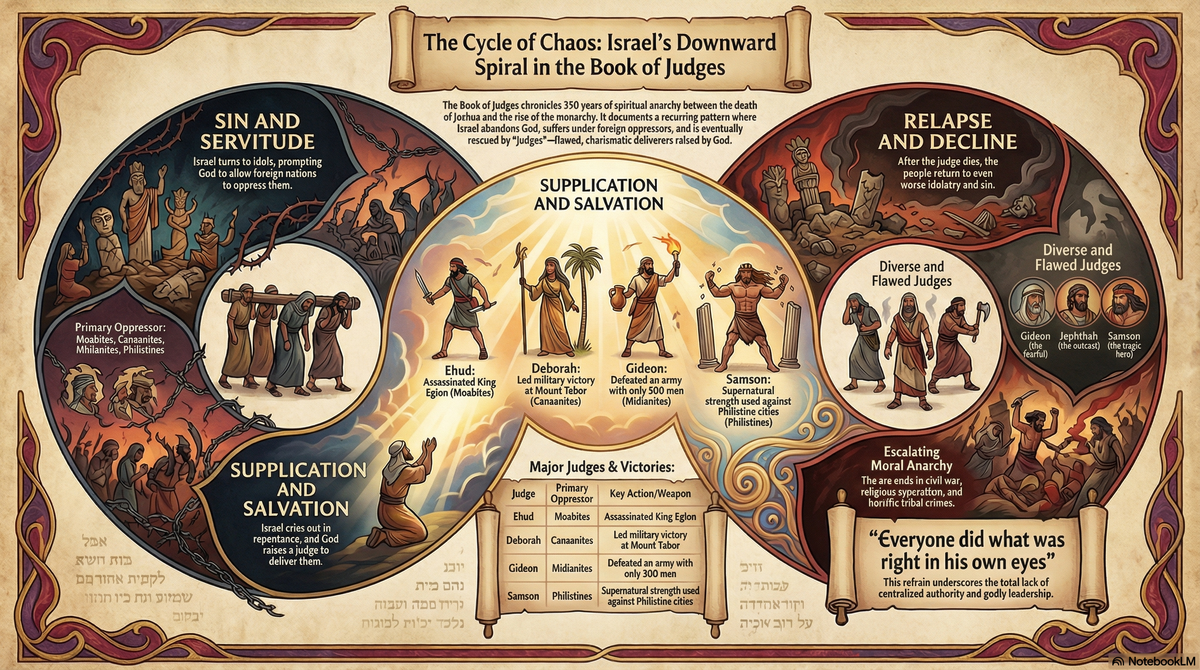
The Book of Judges covers the chaotic period between the death of Joshua and the rise of the monarchy (approximately 300–350 years). It describes how Israel, after Joshua’s generation died, repeatedly turned away from the LORD to worship the gods of the surrounding peoples. God responds by allowing foreign nations to oppress them, yet when Israel cries out in repentance, He raises up “judges” (charismatic deliverers) to rescue them. The book follows a recurring cycle: sin → servitude → supplication → salvation → relapse into sin. After an introductory section explaining why the conquest was incomplete, the narrative presents the major judges, interspersed with minor judges and two extended appendices showing Israel’s moral and religious deterioration. Traditionally attributed to Samuel or a contemporary editor, Judges portrays a dark era of spiritual anarchy, ending with the famous refrain: “In those days there was no king in Israel; everyone did what was right in his own eyes” (17:6; 21:25).
Overall Theme:
The overarching theme of Judges is the spiritual and moral decline of Israel when the people forsake the covenant and live without godly leadership. The book illustrates the truth of Deuteronomy’s warnings: when Israel forgets the LORD and intermarries with Canaanites or adopts their idolatrous practices, they fall under oppression as divine discipline. Yet God remains merciful, raising up flawed but faithful deliverers to save His people when they repent. The repeated cycle reveals both human depravity and divine grace. The book progressively shows worsening apostasy—from simple idolatry to syncretism, civil war, and moral chaos—underscoring the need for a righteous king who will lead the nation in faithfulness to God. Judges serves as a bridge between Joshua’s conquest and the monarchy, demonstrating why Israel needed a king “like all the nations” (1 Samuel 8) and ultimately pointing to the perfect King, Jesus Christ.
Location Settings:
Canaan (the Promised Land) — Primary setting throughout the book.
- Central hill country — Othniel (south), Ehud (near Jericho), Deborah/Barak (Mount Tabor and Jezreel Valley), Gideon (Ophrah in Manasseh), Abimelech (Shechem), Jephthah (Gilead east of Jordan).
- Coastal plain and Philistine territory — Samson’s exploits in the Shephelah and Philistine cities (Timnah, Gaza, Ashkelon).
- Northern regions — Deborah’s battle near Mount Tabor and the Kishon River.
- Shiloh — Early religious center where the tabernacle resides (chs. 18, 21).
- Gibeah (Benjamin) — Site of the horrific crime and civil war (chs. 19–21).
- Danite migration — From south to Laish (later Dan) in the far north (ch. 18).The narrative is decentralized, showing events in different tribal territories, reflecting the lack of centralized authority.
People Involved:
God (the LORD / Yahweh):
Faithful to His covenant; disciplines Israel through oppression yet mercifully raises deliverers when they cry out.
The major judges:
- Othniel — First judge; defeats Cushan-Rishathaim (Mesopotamia).
- Ehud — Left-handed Benjamite; assassinates Moabite king Eglon.
- Shamgar — Kills 600 Philistines with an oxgoad (brief mention).
- Deborah — Prophetess and judge; leads with Barak against Sisera.
- Gideon (Jerubbaal) — Destroys Baal altar; defeats Midianites with 300 men.
- Abimelech — Gideon’s son; usurps power in Shechem; rules tyrannically.
- Jephthah — Outcast from Gilead; defeats Ammonites; tragic vow concerning his daughter.
- Samson — Danite with supernatural strength; fights Philistines; flawed and tragic hero.
Minor judges:
Tola, Jair, Ibzan, Elon, Abdon — brief mentions; provide leadership between major deliverances.
The Israelites:
Repeatedly turn to idolatry, intermarry with Canaanites, and fall into moral chaos.
Foreign oppressors:
Mesopotamians (Cushan-Rishathaim), Moabites (Eglon), Canaanites (Jabin & Sisera), Midianites, Ammonites, Philistines.
Supporting figures:
- Barak — Military leader under Deborah.
- Jael — Kenite woman who kills Sisera.
- Gideon’s father Joash — Protects Gideon.
- Micah — Ephraimite who sets up private shrine (ch. 17).
- The Levite — Hires out to Micah, later serves Danites (chs. 17–18).
- The Levite’s concubine — Victim of horrific crime in Gibeah (ch. 19).
Detailed Chapter Summary:
Chapters 1–3:6 – Introduction: incomplete conquest and cycle explainedTribes fail to fully drive out Canaanites. After Joshua’s death, a new generation arises that does not know the LORD. The cycle of sin, oppression, and deliverance is introduced.
Chapters 3:7–5 – First three judgesOthniel defeats Mesopotamia. Ehud kills Eglon and defeats Moab. Shamgar defeats Philistines. Deborah and Barak defeat Canaanite king Jabin and commander Sisera; Jael kills Sisera; victory song (ch. 5).
Chapters 6–8 – Gideon and MidianIsrael oppressed by Midianites. Gideon called to destroy Baal altar; defeats Midian with 300 men using trumpets and torches. Refuses kingship but makes ephod that becomes idolatrous.
Chapter 9 – Abimelech’s tyrannyGideon’s son Abimelech kills his brothers, rules Shechem; killed by woman dropping millstone on his head.
Chapters 10–12 – Minor judges and JephthahTola, Jair. Jephthah defeats Ammonites but makes tragic vow; daughter becomes dedicated to the LORD. Conflict with Ephraim.
Chapters 13–16 – Samson and the PhilistinesSamson’s birth foretold; Nazirite vow; marries Philistine woman; burns fields with foxes; kills 1,000 with donkey jawbone; betrayed by Delilah; destroys Philistine temple in his death.
Chapters 17–18 – Micah’s idol and Danite migrationEphraimite Micah sets up private shrine and hires Levite. Danites steal idols and priest, conquer Laish, rename it Dan.
Chapters 19–21 – Civil war over Gibeah outrageLevite’s concubine raped and murdered in Gibeah (Benjamin). Tribes assemble, demand justice; Benjamin refuses; civil war nearly wipes out Benjamin; wives provided for survivors.
Closing Prayer:
Gracious and patient God, who never abandoned Your people even when they repeatedly turned from You to worthless idols, we thank You for the book of Judges that reveals both the depth of human sin and the height of Your mercy. In the cycles of rebellion and deliverance, we see our own tendency to forget You and the consequences of doing what is right in our own eyes. Thank You for raising up deliverers—flawed yet used mightily by Your Spirit—to save Your people. Above all, we praise You for sending the perfect Deliverer, Jesus Christ, the righteous King who has defeated sin and death once for all. Grant us grace to remain faithful, to reject every form of idolatry, and to serve You alone until we see our King face to face. To You be glory forever. Amen.
Try Pastor Mugs App
Your KJV Pocket Companion. Faithful insights, verse clarity, guided prayers—ready whenever you open the Word.
Start Free, no strings ->