The Book of Lamentations
Comprehensive overview of Lamentations — five acrostic poems mourning Jerusalem’s destruction, confessing sin, acknowledging God’s righteous judgment, and clinging to His mercies that are new every morning, pointing to ultimate restoration in Christ.
Summary
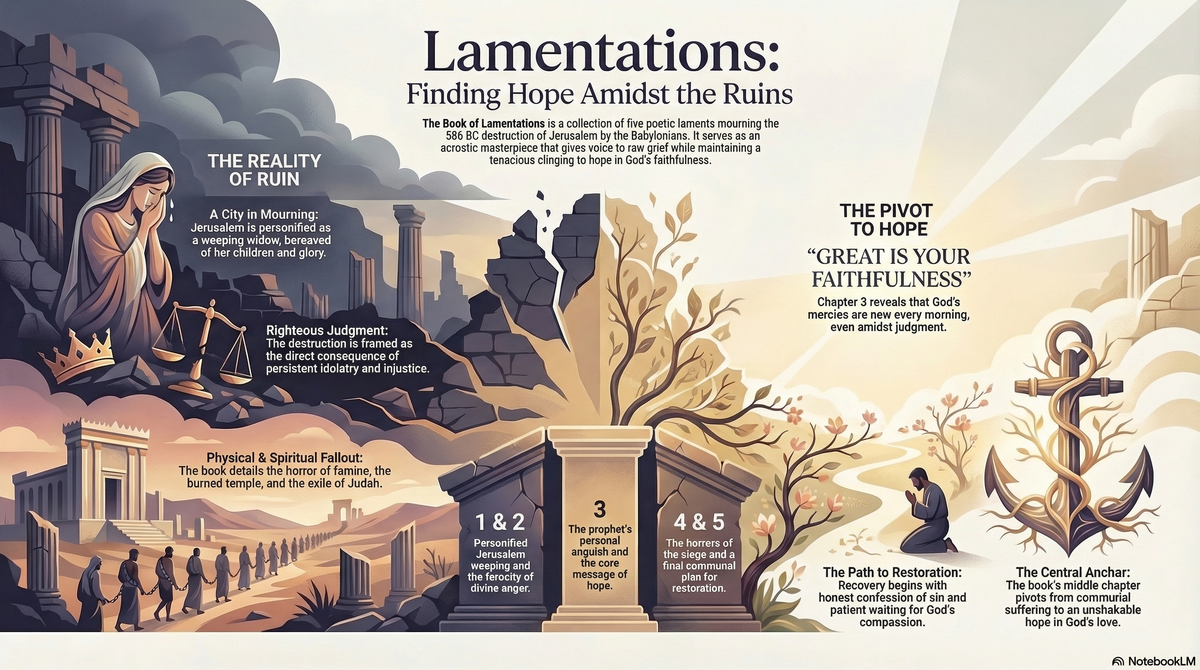
The Book of Lamentations is a short but deeply moving collection of five poetic laments mourning the destruction of Jerusalem and the temple by the Babylonians in 586 BC.
Traditionally attributed to the prophet Jeremiah (though the text itself does not name its author), the book is an acrostic masterpiece in Hebrew poetry, with chapters 1, 2, 3, and 4 structured as alphabetic acrostics (each verse or stanza beginning with successive letters of the Hebrew alphabet), and chapter 5 as a non-acrostic prayer.
The work reflects the immediate aftermath of Jerusalem’s fall, the exile of Judah’s people, and the profound grief over the loss of city, temple, and national identity. It covers no extended timeline but focuses on a single cataclysmic event and its emotional and spiritual fallout.
The book divides into five chapters, each a separate lament or prayer: personified Jerusalem weeping (chs. 1–2), the prophet’s personal anguish and hope (ch. 3), communal suffering (ch. 4), and a final plea for restoration (ch. 5). Written in the shadow of the exile, Lamentations gives voice to raw grief, confession of sin, acknowledgment of God’s righteous judgment, and a tenacious clinging to hope in God’s steadfast love.
Overall Theme
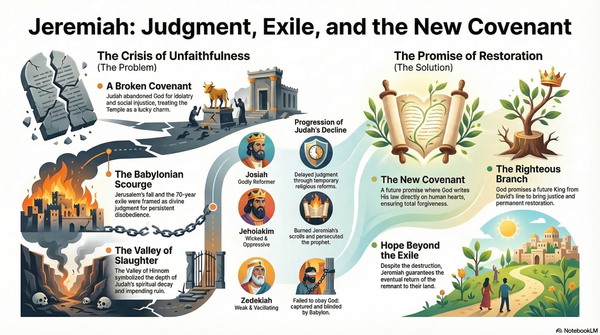
The overarching theme of Lamentations is the bitter sorrow of divine judgment on covenant unfaithfulness, yet the enduring hope that rests in the steadfast love (hesed) and faithfulness of God. The book unflinchingly confronts the horror of Jerusalem’s destruction—famine, slaughter, exile, desecration of the temple—as the direct consequence of Judah’s persistent idolatry, injustice, and rejection of God’s prophets.
The repeated acknowledgment that “the LORD is righteous” (1:18) and “He has done what He said” (2:17) affirms that God’s judgment is just. Yet amid the ashes, the central chapter (3) pivots to hope:
“The steadfast love of the LORD never ceases; his mercies never come to an end; they are new every morning; great is your faithfulness” (3:22–23). Lamentations teaches that true mourning includes honest confession of sin, submission to God’s discipline, and patient waiting on His compassion. It models how God’s people can grieve deeply without despair, trusting that the same God who judges is the God who restores. The book foreshadows the ultimate hope in Christ, who wept over Jerusalem (Luke 19:41), bore the full weight of divine judgment on the cross, and rose to bring new life and a new covenant.
Location Settings
Jerusalem (Zion / the city of Judah) — The sole and all-consuming setting of the book.
- The ruined city is personified as a weeping widow (chs. 1–2); streets empty, gates desolate, temple defiled and burned.
- The temple — Once the glory of Zion, now a place of horror: its stones poured out, its precious things given to enemies (2:6–9; 4:1).
- The streets and roads — Filled with the dead, starving children, and fleeing refugees (1:4, 19; 2:11–12; 4:18).
- The walls and gates — Broken down, occupied by enemies (2:8–9).
- The hills and mountains around Jerusalem — Witnesses to the siege and destruction (1:2; 5:18).
The land of Judah — Mentioned broadly as desolate and abandoned (5:2–3).Exile in foreign lands — The people scattered among the nations, no resting place (1:3; 5:2).The entire book is anchored in the physical and emotional ruins of Jerusalem, with no scenes in Babylon or elsewhere; the focus is on the devastated city as the symbol of God’s judgment and the place where hope must be reborn.
People Involved
God (the LORD / Yahweh):
The sovereign Judge who has brought calamity as punishment for sin, yet the compassionate One whose mercies are new every morning; the ultimate object of lament and hope.
Jeremiah (the prophet):
Traditionally the author speaks in first person in chapter 3 (and possibly elsewhere); weeps bitterly for the city and people, yet clings to God’s faithfulness.
Jerusalem / Zion (personified as a widow / daughter):
The grieving city herself; bereaved of husband (God), children (people), and glory; weeps, laments, confesses, and pleads.
The people of Judah / the remnant:
Starving, slain, exiled, humiliated; mothers who eat their children in famine (2:20; 4:10); young and old suffering together; confess collective guilt.
The enemies / adversaries (Babylonians):
The instruments of God’s judgment; mockers, destroyers, invaders who rejoice over Jerusalem’s fall (1:21; 2:15–16).
The former allies / lovers:
Nations that once befriended Judah but now abandon or betray her (1:2, 19).
The priests and prophets:
Guilty of leading the people into sin; their blood shed in the streets (4:13–14).
Supporting figures / groups:
- The princes / nobles — Once honored, now despised (1:6; 4:7–8).
- The young men and maidens — Once joyful, now dead or enslaved (1:18; 5:13).
- The children and infants — Starving, dying in mothers’ arms (2:11–12; 4:4).
Detailed Chapter Summary
Chapter 1 – Jerusalem’s desolation
The city weeps bitterly; her lovers have forsaken her; her children are captive; she acknowledges her sin and God’s righteousness.
Chapter 2 – God’s fierce anger
The Lord has become like an enemy; swallowed up Israel; destroyed palaces and temple; no compassion in the day of wrath; mothers eat their children.
Chapter 3 – The prophet’s personal lament and hope
“I am the man who has seen affliction”; God’s anger, yet “the steadfast love of the LORD never ceases… great is your faithfulness”; hope in waiting quietly for salvation; call to repentance.
Chapter 4 – The horrors of the siege
Gold dimmed, children starving, priests and prophets slain; former beauty turned to horror; sin greater than Sodom’s; yet God’s judgment complete.
Chapter 5 – Final plea for restoration
Communal prayer: remember our affliction; our inheritance taken, fathers sinned, we bear their iniquity; joy gone; yet “restore us to yourself, O LORD… renew our days as of old” (5:21).
Closing Prayer:
Merciful and holy God, the Righteous Judge who disciplines those You love, we thank You for the Book of Lamentations that gives voice to the deepest grief of Your people when judgment falls. In the tears of Jerusalem, the anguish of the prophet, and the horrors of a city destroyed, we see the terrible cost of turning from You. Yet in the heart of the lament, we hear the unshakable truth: Your steadfast love never ceases, Your mercies are new every morning, great is Your faithfulness.
Thank You for not abandoning Your people in exile but promising a new covenant and a new creation. Above all, we praise You for Jesus Christ, who wept over Jerusalem, bore the full weight of divine judgment on the cross, and rose to bring eternal restoration.
Grant us grace to mourn our sin, to confess honestly, to wait patiently in hope, and to trust that You are good to those who wait for You. Renew our days as of old until the day we see the New Jerusalem descending, where there is no more death, mourning, crying, or pain, and You wipe every tear from our eyes. To You be glory forever. Amen.