The Book of Psalms: Israel’s Hymnbook of Prayer and Praise — Full Book Summary and Key Themes
Comprehensive overview of the Book of Psalms — 150 songs and prayers expressing every human emotion before God, from lament and confession to triumphant praise, centered on Yahweh’s sovereignty, steadfast love, and messianic hope fulfilled in Christ.

Summary
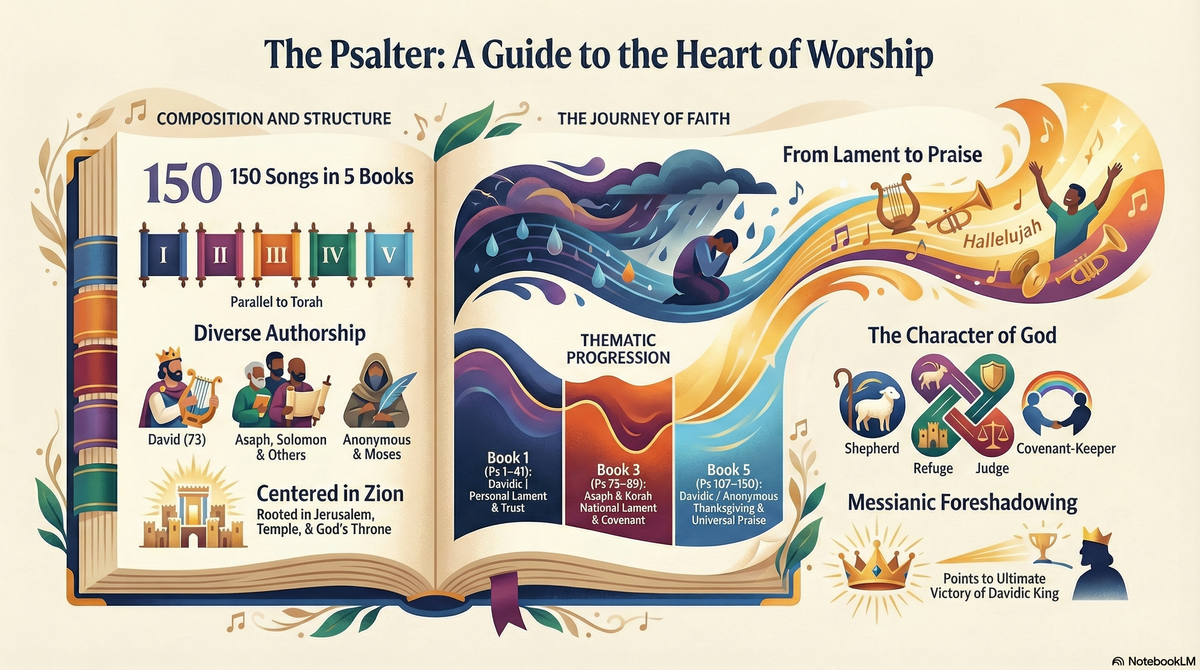
The Book of Psalms, also known as the Psalter, is the Bible’s divinely inspired hymnbook and prayer book, containing 150 individual psalms (songs, prayers, and poems) that express the full range of human emotion and experience in relationship with God.
Traditionally attributed primarily to David (about 73 psalms bear his name), with contributions from Asaph (12), the sons of Korah (11), Solomon (2), Moses (1), Heman, Ethan, and anonymous authors, the collection was compiled over centuries and finalized in the post-exilic period. The psalms cover no single historical narrative or timeline but span Israel’s history—from Moses’ prayer (Psalm 90) through David’s life, the monarchy, exile, and restoration. They were used in temple worship, private devotion, and synagogue liturgy.
The book is divided into five “books” (1–41, 42–72, 73–89, 90–106, 107–150), each ending with a doxology, mirroring the five books of the Torah. Psalms encompasses laments (individual and communal), thanksgiving songs, hymns of praise, royal psalms, wisdom psalms, imprecatory psalms, messianic psalms, and songs of ascent. The collection moves broadly from lament and struggle (Book 1) toward praise and hope (Book 5), culminating in the great Hallelujah psalms (146–150).
Overall Theme:
The overarching theme of the Book of Psalms is the sovereign goodness and faithfulness of God as the worthy object of worship, trust, and prayer in every circumstance of life. The psalms portray God as Creator, King, Shepherd, Refuge, Judge, Redeemer, and Covenant-Keeper who hears the cries of His people. Human experience ranges from exuberant praise (“Bless the LORD, O my soul!”) to deep despair (“My God, my God, why have You forsaken me?”), yet the consistent response is to turn to Yahweh in honest lament, confident hope, and joyful worship.
Key recurring motifs include God’s steadfast love (hesed), His righteousness and justice, His power over creation and nations, and His special relationship with Israel and the Davidic king. Many psalms are messianic, pointing forward to the ultimate Davidic King—Jesus Christ—who fulfills the royal, suffering, and victorious themes (e.g., Psalms 2, 22, 110).
The Psalter teaches that true worship involves the whole person—mind, heart, and voice—expressing both joy and sorrow before God. It models honest prayer, communal praise, and trust in God’s ultimate victory over evil and suffering, culminating in universal praise to the LORD.
Location Settings:
The Book of Psalms is not a narrative with sequential locations but a collection of poetic prayers and songs rooted in Israel’s historical and spiritual geography. Settings are evoked poetically rather than described geographically.
Jerusalem / Zion / the Temple Mount — The spiritual and emotional center of many psalms.
- Zion is celebrated as God’s holy hill, the city of the Great King (Psalms 46, 48, 87, 132).
- The temple is the place of sacrifice, praise, and God’s presence (Psalms 5, 27, 65, 84, 122, 134).
- Songs of Ascent (Psalms 120–134) were sung by pilgrims traveling to Jerusalem for festivals.
The land of Israel / Promised Land — Frequently referenced as the inheritance of God’s people.
- Hills, mountains, valleys, rivers (Jordan, streams of Lebanon), and wilderness evoke God’s creation and provision (Psalms 65, 104, 114).
- Enemies surround from surrounding nations (Philistines, Edom, Moab, Assyria, Babylon).
The heavenly throne room / God’s heavenly sanctuary — God reigns above the heavens, above the chaos waters, enthroned on the cherubim (Psalms 29, 93, 99, 103).
Personal and universal settings — The psalmist’s bed at night (lament), the sanctuary (vows), the city gate (justice), the battlefield (victory), the shepherd’s field (Psalm 23), the lion’s den or fiery furnace (figurative for danger).
The “location” is often the human heart in communion with God—whether in joy, sorrow, exile, or pilgrimage—making the Psalter timeless and universal.
People Involved:
God (the LORD / Yahweh / Elohim / Adonai):
Central figure; the Holy One of Israel, Creator of heaven and earth, King over all nations, Shepherd of His people, Refuge, Judge, Redeemer, and source of steadfast love and salvation.
David:
Dominant human voice; the sweet psalmist of Israel; author of many psalms reflecting his life—persecution by Saul, sin with Bathsheba (Psalm 51), victories, family troubles, and devotion to God.
The psalmists (various):
- Asaph and sons of Korah — Temple musicians and poets; many communal laments and hymns.
- Solomon — Psalms 72 and 127 (wisdom and blessing).
- Moses — Psalm 90 (prayer for wisdom amid mortality).
- Anonymous / community — Many psalms express the voice of the people, the poor, the righteous sufferer, or the exilic community.
The righteous / the godly / the poor:
Those who trust in the LORD, suffer unjustly, and cry out for deliverance (frequent in laments).
The wicked / evildoers / enemies:
Those who oppose God and His people; often portrayed as arrogant, violent, or idolatrous; subject to God’s judgment.
The nations / kings of the earth:
Called to worship Yahweh (Psalm 2, 47, 96–99); sometimes portrayed as raging against God and His Anointed.
The Anointed One / the King / the Son:
Messianic figure in royal psalms (2, 45, 72, 89, 110, 132); ultimately fulfilled in Christ.
Supporting figures / groups:
- Enemies (Saul, Absalom, foreign nations).
- The afflicted / prisoners / orphans / widows — Objects of God’s compassion.
- The heavens, earth, sea, animals — Personified as praising God (Psalm 148).
Detailed Chapter Summary
Book 1 (Psalms 1–41)
Introduction: Two ways (blessed righteous vs. wicked, Psalm 1). Many Davidic psalms of lament (3–7, 12–14, 22, 25–28), trust (11, 16, 23), thanksgiving (18, 30, 32–34), and praise (8, 19, 29). Messianic Psalm 2; penitential Psalm 32.
Book 2 (Psalms 42–72)
Korahite and Asaph psalms; longing for God in exile (42–43), God’s presence in the sanctuary (46, 48). Davidic psalms of distress and deliverance (51 penitential, 52–57). Climax in Psalm 72 (Solomon’s prayer for the king’s reign).
Book 3 (Psalms 73–89)
Asaph and Korah psalms; struggle with prosperity of wicked (73), God’s faithfulness despite national disaster (74–83). Ends with lament over the broken Davidic covenant (89).
Book 4 (Psalms 90–106)
Moses’ prayer (90); Yahweh as King over creation and nations (93–99). Historical psalms recounting God’s acts (105–106) and Israel’s rebellion.
Book 5 (Psalms 107–150)
Thanksgiving for deliverance (107); Songs of Ascent (120–134) for pilgrims. Davidic psalms of trust (138–145). Hallelujah psalms (146–150) call all creation to praise the LORD.
Closing Prayer:
Eternal God, enthroned in the heavens yet near to the brokenhearted, we thank You for the Book of Psalms that gives voice to every human cry and joy in Your presence. In the laments of the afflicted, the praises of the redeemed, the confessions of the repentant, and the exultation of all creation, we see the full spectrum of life lived before You. Thank You for David and all the psalmists who teach us to bring everything—pain, sin, wonder, and victory—to You in honest prayer.
Above all, we praise You for the greater David, Jesus Christ, who prayed the psalms on the cross (“My God, why have You forsaken me?”), fulfilled every messianic promise, and now leads the eternal song of redemption. Grant us grace to sing Your praises in every season, to trust Your steadfast love when answers are delayed, and to join the chorus of heaven until every knee bows and every tongue confesses that You alone are worthy. To You be glory forever. Amen.