The Book of Ruth: Loyalty, Providence, and Redemption
Complete overview of the Book of Ruth — a Moabite widow’s faithfulness to Naomi, her meeting with Boaz the kinsman-redeemer, and their place in the genealogy of David, showcasing God’s providential care and redeeming love.
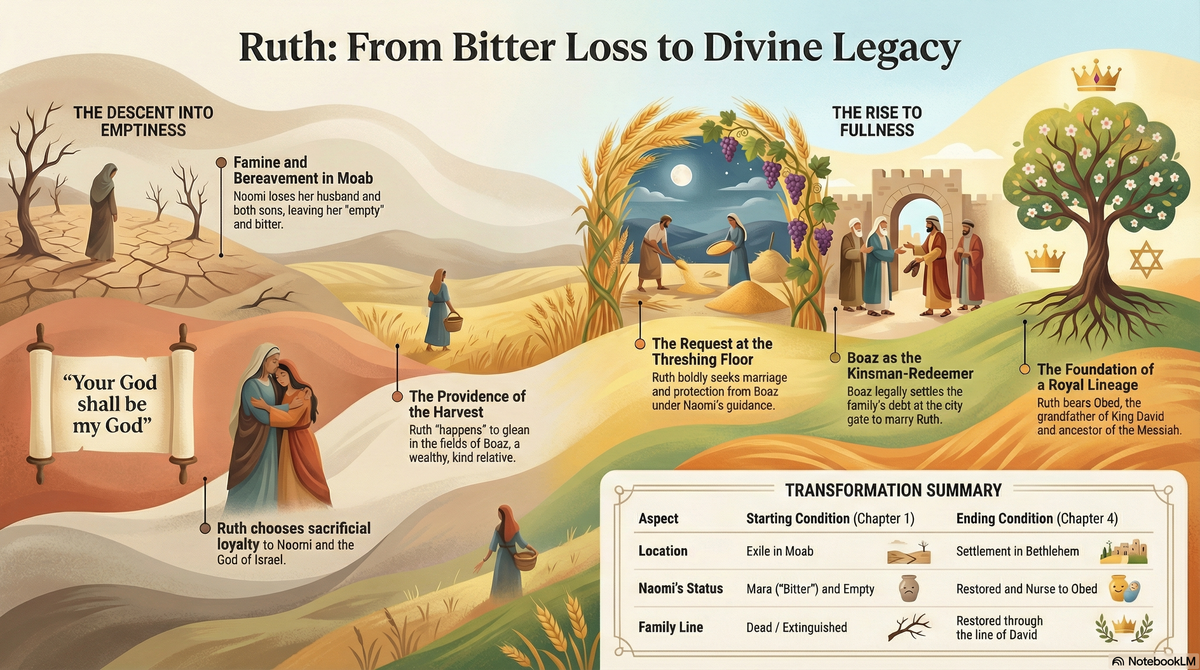
Summary
The Book of Ruth is a short, beautiful narrative set “in the days when the judges ruled” (1:1), offering a tender contrast to the chaos and moral decline chronicled in Judges. It tells the story of a Moabite widow, Ruth, who chooses loyalty to her Israelite mother-in-law, Naomi, and to Naomi’s God, ultimately becoming part of the lineage of King David—and thus of the Messiah. Traditionally attributed to Samuel or an early compiler, the book is a masterpiece of literary artistry, structured around four chapters that move from emptiness and loss to fullness and redemption. It covers perhaps a decade or less, focusing on events in Bethlehem and its surrounding fields during the barley and wheat harvests. Ruth demonstrates God’s providential care in ordinary lives, the value of covenant loyalty (hesed), and the inclusion of Gentiles in God’s redemptive plan.
Overall Theme:
The overarching theme of Ruth is God’s sovereign providence and redeeming faithfulness working through human loyalty and kindness in the midst of hardship. Amid the spiritual darkness of the judges’ era, Ruth shines as a story of quiet grace: God orchestrates events—famine, death, return, gleaning, nighttime encounter, and legal redemption—to restore Naomi’s empty life and bring Ruth into the covenant community. The keyword hesed (“loyal love,” “kindness,” “steadfast love”) appears repeatedly, describing Ruth’s devotion to Naomi, Boaz’s generosity to Ruth, and ultimately God’s covenant faithfulness to His people. The book contrasts human emptiness (Naomi’s “bitter” name change, 1:20–21) with divine fullness (marriage, child, genealogy). It foreshadows the greater redemption through the line of David, showing that God’s plan includes outsiders (a Moabite widow) and works through ordinary faithfulness rather than dramatic miracles or military conquests. Ruth illustrates how God uses personal integrity, sacrificial love, and covenant obedience to advance His redemptive purposes.
Location Settings:
Bethlehem of Judah — The primary and most significant setting, called “Bethlehem Ephrathah” (Micah 5:2).
- The story begins and ends here. Naomi’s family leaves Bethlehem because of famine (1:1) and returns to it after the famine ends (1:19–22).
- Bethlehem’s fields are central: Ruth gleans in Boaz’s fields during the barley and wheat harvests (chs. 2–3).
- The city gate serves as the place of legal transactions and community witness (4:1–12), where Boaz redeems Ruth and the land.
The country of Moab — East of the Dead Sea; Naomi’s family sojourns here during the famine; Elimelech dies, his sons marry Moabite women, and the sons die (1:1–5). Moab is portrayed neutrally—Ruth comes from here but chooses Israel’s God.
The road between Moab and Bethlehem — The poignant journey of Naomi and Ruth back to Judah (1:6–18), including the famous “entreat me not to leave you” speech at a crossroads.
The narrative is tightly localized, moving from exile in Moab to return and settlement in Bethlehem, symbolizing restoration and belonging.
People Involved:
God (the LORD / Yahweh):
Quietly sovereign throughout; He visits His people by ending the famine (1:6), guides Ruth to Boaz’s field (2:3—“her hap was to light on” his portion), and grants conception (4:13). His providence is the unseen main actor.
Naomi (later calls herself Mara, “bitter”):
Widow of Elimelech; mother-in-law to Ruth and Orpah; returns empty from Moab but is restored through Ruth and Boaz; becomes nurse to Obed.
Ruth:
Moabite widow; daughter-in-law of Naomi; chooses to stay with Naomi, embraces Israel’s God (“your God [shall be] my God,” 1:16); works diligently as a gleaner; boldly seeks redemption through Boaz; becomes wife of Boaz and great-grandmother of David.
Boaz:
Wealthy relative of Elimelech (“a man of standing,” 2:1); landowner in Bethlehem; shows extraordinary kindness (hesed) to Ruth; acts as kinsman-redeemer (go’el), marries Ruth, fathers Obed.
Elimelech (and sons Mahlon and Chilion):
Naomi’s husband and two sons; die in Moab, leaving three widows.
Orpah:
Other Moabite daughter-in-law; returns to her people and gods (1:14–15).
Supporting figures:
- The women of Bethlehem — greet Naomi’s return and later bless her at Obed’s birth.
- The elders and witnesses at the city gate — confirm Boaz’s redemption transaction.
- The nearer kinsman (unnamed) — first eligible redeemer who declines when it involves Ruth (4:1–6).
Obed:
Son of Boaz and Ruth; grandfather of David; restores Naomi’s life and hope.
Detailed Chapter Summary
Chapter 1 – From fullness to emptiness
A famine drives Elimelech’s family from Bethlehem to Moab. Elimelech dies; sons marry Moabite women (Orpah and Ruth); sons die. Naomi hears the famine has ended and decides to return. Ruth refuses to leave her (“Where you go I will go… your people shall be my people, and your God my God,” 1:16–17). They arrive in Bethlehem at the beginning of barley harvest; Naomi says, “Call me Mara, for the Almighty has dealt very bitterly with me” (1:20).
Chapter 2 – Ruth’s gleaning and Boaz’s kindness
Ruth goes to glean in the fields and “happens” upon Boaz’s field. Boaz notices her, inquires about her, and shows extraordinary favor: protection, extra food, water, and permission to glean among the sheaves. He instructs his workers to leave extra grain for her. Ruth reports to Naomi, who recognizes Boaz as a close relative.
Chapter 3 – Ruth’s bold request at the threshing floor
Naomi instructs Ruth to wash, dress, and go to the threshing floor at night after Boaz has eaten and drunk. Ruth uncovers Boaz’s feet and lies down—a culturally understood request for marriage and protection. Boaz praises her loyalty, notes her reputation, agrees to redeem her if the nearer kinsman refuses, and sends her home with grain before dawn.
Chapter 4 – Redemption and restoration
At the city gate, Boaz confronts the nearer kinsman, who initially agrees to redeem the land but declines when it includes marrying Ruth (to preserve his own inheritance). Boaz publicly redeems the land and takes Ruth as wife. The elders bless the union. Ruth bears a son, Obed. The women bless Naomi: “He shall be to you a restorer of life.” The genealogy traces Obed to Jesse to David.
Closing Prayer:
Sovereign and gracious God, who in the quiet providence of ordinary lives weave the threads of Your great redemption, we thank You for the book of Ruth that shows Your steadfast love shining in the darkest times. In Ruth’s loyal devotion, Boaz’s generous redemption, and Naomi’s restoration from emptiness to fullness, we see foreshadows of Christ, our Kinsman-Redeemer, who left His heavenly home, took our poverty, and brought us into Your family. Thank You for including outsiders like Ruth in Your covenant people and for working all things for the good of those who love You. Grant us grace to show hesed—loyal, sacrificial kindness—to one another, to trust Your unseen hand in our hardships, and to live faithfully until we see the greater Son of David who reigns forever. To You be glory and praise. Amen.
Try Pastor Mugs App
Your KJV Pocket Companion. Faithful insights, verse clarity, guided prayers—ready whenever you open the Word.
Start Free, no strings ->