The Book of the Prophet Isaiah: Judgment, Messiah, and Glorious Restoration — Full Book Summary and Key Themes
Comprehensive overview of Isaiah — prophecies of judgment on Judah and the nations, the promise of Immanuel and the Suffering Servant, comfort to exiles, and the vision of new heavens and new earth, revealing God’s holiness and redemptive plan fulfilled in Christ.
Summary
The Book of Isaiah is one of the longest and most profound prophetic books in the Bible, spanning 66 chapters and covering a vast theological and historical scope. Traditionally attributed to the prophet Isaiah son of Amoz, who ministered in Jerusalem during the reigns of Uzziah, Jotham, Ahaz, and Hezekiah (c. 740–681 BC), many scholars propose a multi-author composition: “First Isaiah” (chs. 1–39, 8th century BC), “Second Isaiah” (chs. 40–55, exilic period), and “Third Isaiah” (chs. 56–66, post-exilic).
However, the NKJV and traditional Christian view regard the book as a unified work from Isaiah, with later sections delivered prophetically concerning the future exile and restoration. Isaiah addresses Judah’s sin, impending judgment through Assyria and Babylon, yet promises ultimate salvation, a coming Messiah, a new covenant, and a glorious future kingdom.
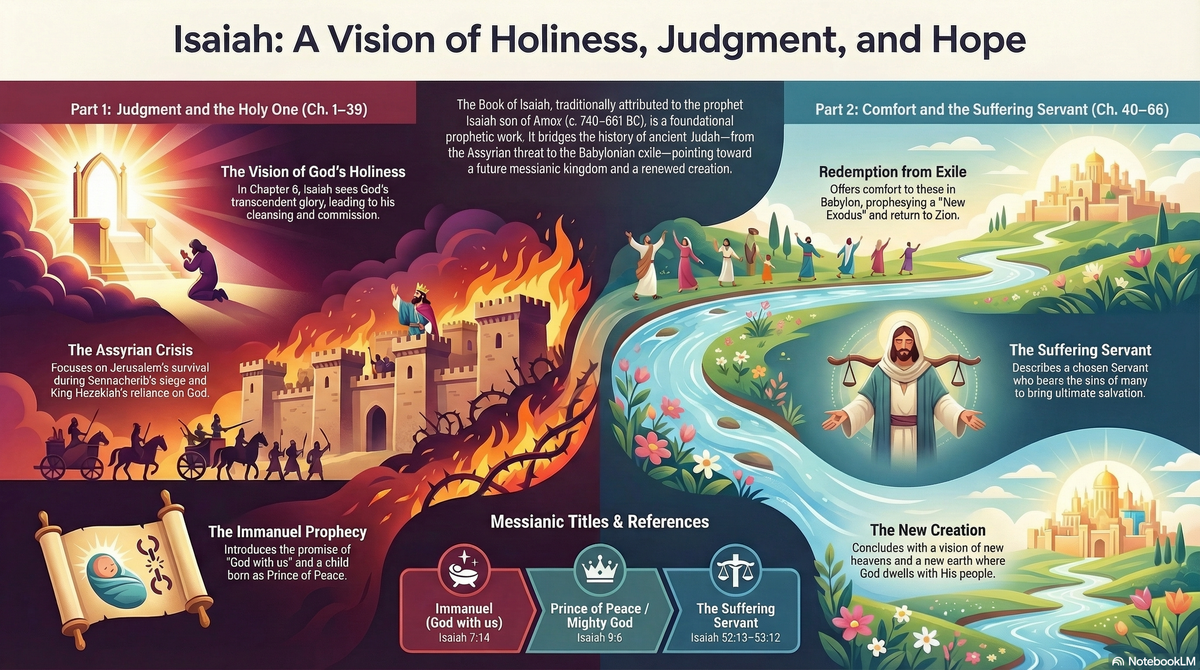
The book divides into two major sections: judgment and hope in the context of Assyrian threat (chs. 1–39) and comfort, redemption, and eschatological glory after Babylonian exile (chs. 40–66). It includes oracles against Judah and the nations, historical narratives (chs. 36–39), servant songs, and visions of a renewed creation.
Overall Theme:
The overarching theme of Isaiah is God’s holy judgment on sin and His sovereign plan of redemption through the coming Messiah, culminating in a new heavens and new earth where His glory dwells with His redeemed people. Isaiah reveals God as the Holy One of Israel—transcendent, majestic, and morally perfect—who cannot tolerate sin yet is rich in mercy. The book repeatedly contrasts human pride and idolatry with God’s sovereignty (“I am the LORD, and there is no other,” 45:5–6).
Judgment falls on Judah for covenant unfaithfulness, on surrounding nations for arrogance, and ultimately on all creation, yet grace triumphs: God promises a remnant preserved, a suffering Servant who bears sin, a Davidic King who reigns in righteousness, and a final restoration where death is swallowed up and God wipes away every tear. The messianic hope is central—Immanuel (“God with us”), the child born as Wonderful Counselor, Mighty God, Everlasting Father, Prince of Peace (9:6), the shoot from Jesse (11:1), the Servant who is despised yet exalted (52:13–53:12). Isaiah bridges judgment and salvation, exile and return, the present age and the age to come, pointing unmistakably to Jesus Christ as the fulfillment of its promises.
Location Settings:
Jerusalem / Judah / the Southern Kingdom — Primary setting for much of the book.
- Isaiah ministers in Jerusalem during the reigns of Uzziah, Jotham, Ahaz, and Hezekiah; the city is addressed as God’s chosen place yet threatened by sin (chs. 1–5).
- The temple is central: Isaiah’s vision of God’s holiness (ch. 6), Hezekiah’s prayer and reforms (chs. 36–39).
- The surrounding countryside, valleys, and mountains of Judah are depicted in judgment oracles and promises of restoration.
Assyria and its cities — The northern threat in chs. 1–39.
- Nineveh, the capital (though more prominent in Jonah and Nahum), represents Assyrian arrogance; oracles against Assyria (chs. 7–10, 36–37).
- Sennacherib’s siege of Jerusalem (chs. 36–37) is the major historical event.
Babylon — Dominant in chs. 13–14, 39, and especially 40–55.
- Oracle against Babylon (chs. 13–14); its fall prophesied.
- The exilic setting: God’s people in Babylonian captivity (chs. 40–55); promises of return from Babylon (48:20).
The nations — Oracles against Philistia, Moab, Damascus (Syria), Cush (Ethiopia), Egypt, Edom, Arabia, Tyre (chs. 13–23).
- Universal scope: God judges all nations yet will gather them to Zion in the end.
The eschatological / renewed creation — Future-oriented settings in chs. 11, 24–27, 65–66.
- New heavens and new earth (65:17; 66:22); Zion transformed into a place of joy; the wolf and lamb feeding together; no more weeping or death.
The book moves from 8th-century Jerusalem under Assyrian threat, through Babylonian exile, to the ultimate new creation centered on a glorified Zion.
People Involved
God (the LORD / Yahweh / Holy One of Israel):
Central figure; sovereign, holy, just, merciful; the only true God who judges sin yet redeems through His Servant.
Isaiah son of Amoz:
The prophet; receives visions, calls Judah to repentance, prophesies judgment and hope; his call in the temple (ch. 6); historical interactions with Ahaz and Hezekiah.
Uzziah, Jotham, Ahaz, Hezekiah — Kings of Judah during Isaiah’s ministry.
- Ahaz — Wicked; refuses sign of Immanuel, seeks Assyrian help (ch. 7).
- Hezekiah — Godly; reforms, prays during Assyrian siege; shown Babylonian envoys (chs. 36–39).
The Messiah / the Anointed One / the Servant:
Multiple titles and prophecies: Immanuel (7:14), Wonderful Counselor, Mighty God (9:6), Branch from Jesse (11:1), suffering Servant (chs. 42, 49, 50, 52–53), anointed preacher of good news (61:1).
The remnant / the redeemed:
The faithful few preserved through judgment; return from exile; inherit the new creation.
The nations / kings of the earth:
Judged for pride (chs. 13–23); some humbled, others invited to worship at Zion.
Supporting figures:
- Sennacherib — Assyrian king; besieges Jerusalem; defeated by God’s angel.
- Rabshakeh — Assyrian commander; taunts Judah.
- Shebna and Eliakim — Officials in Hezekiah’s court.
- Cyrus — Persian king; God’s anointed to release exiles (44:28–45:1).
- Babylon’s king — Symbol of pride and tyranny (ch. 14).
Detailed Chapter Summary:
Chapters 1–5 – Judgment on Judah
Indictment of sin, hypocrisy in worship; call to repentance. Song of the vineyard (ch. 5): Judah as unfruitful vineyard.
Chapter 6 – Isaiah’s call
Vision of God’s holiness; seraphim cry “Holy, holy, holy”; Isaiah cleansed, commissioned.
Chapters 7–12 – Immanuel prophecies
Ahaz refuses sign; promise of Immanuel child. Assyrian invasion; hope in the child born as Prince of Peace. Messianic kingdom (ch. 11).
Chapters 13–23 – Oracles against the nations
Babylon, Philistia, Moab, Damascus, Ethiopia, Egypt, Edom, Arabia, Tyre; God’s sovereignty over all.
Chapters 24–27 – Little Apocalypse
Judgment on the whole earth; resurrection hope; God’s people delivered.
Chapters 28–35 – Woes and promises
Judgment on Ephraim (Israel), Jerusalem; future glory of Zion.
Chapters 36–39 — Historical narrative
Sennacherib’s siege; Hezekiah’s prayer; deliverance. Hezekiah’s illness and recovery; Babylonian envoys; prophecy of exile.
Chapters 40–55 — Book of Comfort
Comfort to exiles; God’s incomparable power; Cyrus as deliverer; four Servant Songs (42:1–9; 49:1–13; 50:4–11; 52:13–53:12); new exodus from Babylon.
Chapters 56–66 — Final vision
Salvation for foreigners; judgment on the wicked; new heavens and new earth; God’s glory fills Zion.
Closing Prayer:
Holy and sovereign God, the Holy One of Israel, whose glory fills the temple and whose name is exalted above every name, we thank You for the book of Isaiah that unveils both Your righteous judgment on sin and Your astonishing plan of redemption. In Isaiah’s vision of Your holiness, in the promise of Immanuel, in the Suffering Servant who bears our iniquities, and in the vision of new heavens and new earth, we see the full sweep of Your grace.
Thank You for sending Your Son, Jesus Christ, the fulfillment of every messianic hope—the child born, the Servant slain, the King who reigns forever. Forgive us when we trust in our own righteousness or alliances rather than in You. Grant us grace to heed Isaiah’s call to wash ourselves, cease evil, and seek justice, and to rest in Your promise that though weeping may endure for a night, joy comes in the morning. May we live as those redeemed by Your Servant, proclaiming good news to the poor until every knee bows and every tongue confesses that Jesus Christ is Lord, to Your eternal glory. Amen.