The Book of the Prophet Jeremiah: Judgment, Lament, and the Promise of a New Covenant
Comprehensive overview of Jeremiah — the weeping prophet’s ministry during Judah’s final decades, warnings of Babylonian judgment, personal laments, symbolic actions, oracles against nations, and the glorious promise of restoration and a new covenant fulfilled in Christ.
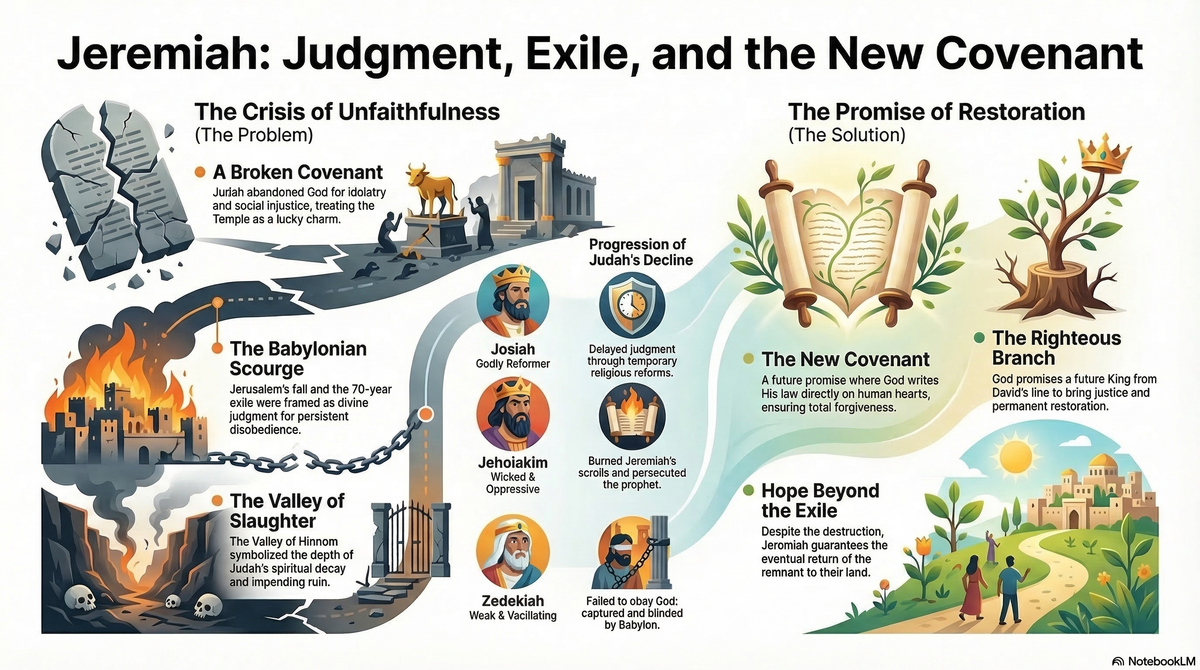
The Book of Jeremiah is one of the longest prophetic books in the Bible, containing the prophet’s oracles, biographical narratives, laments, and symbolic actions during one of Judah’s most turbulent periods. Jeremiah, son of Hilkiah, a priest from Anathoth, was called by God as a young man in the thirteenth year of King Josiah (c. 627 BC) and continued prophesying through the reigns of Josiah, Jehoahaz, Jehoiakim, Jehoiachin, and Zedekiah, until after the fall of Jerusalem in 586 BC (c. 627–580 BC).
Traditionally attributed to Jeremiah himself with significant contributions from his scribe Baruch, the book is not strictly chronological but a compilation of messages, events, and laments organized thematically and roughly by reign. It covers roughly fifty years, from Josiah’s reforms through the Babylonian conquest, the destruction of Jerusalem and the temple, and the aftermath in Egypt and Babylon.
The book divides into several major sections: early oracles and the call of Jeremiah (chs. 1–6), the temple sermon and covenant-breaking (chs. 7–10), symbolic actions and warnings (chs. 11–20), oracles against Judah and the nations (chs. 21–25), the historical narrative of the final days (chs. 26–45), and oracles against foreign nations plus the promise of restoration (chs. 46–52).
Overall Theme:
The overarching theme of Jeremiah is God’s righteous judgment on covenant unfaithfulness and His persistent, merciful offer of restoration through repentance and a coming new covenant. Jeremiah repeatedly indicts Judah for idolatry, injustice, false prophecy, and reliance on foreign alliances rather than God.
The people have broken the covenant made at Sinai, treating the temple as a talisman of safety rather than a call to holiness (“the temple of the LORD, the temple of the LORD, the temple of the LORD!” 7:4). Yet God’s heart is broken with longing—He pleads with His people to return, promising forgiveness if they repent (3:12–14; 18:7–10).
The book’s most famous promise is the new covenant (31:31–34): God will write His law on their hearts, forgive iniquity, and remember sin no more—a prophecy fulfilled in Christ (Hebrews 8:8–12). Jeremiah portrays God as both holy Judge and wounded Lover, sovereign over nations (including Babylon as His servant), yet deeply personal.
The prophet’s own suffering—persecution, imprisonment, loneliness—mirrors the nation’s judgment and points forward to the suffering of the Messiah. Jeremiah teaches that true security is found only in returning to the LORD, and that even after devastating judgment, God remains faithful to His promises of restoration and a righteous Branch from David.
Location Settings:
Jerusalem / Judah / the Southern Kingdom — The central and dominant setting throughout the book.
- The temple in Jerusalem is a recurring focal point: Jeremiah’s temple sermon (ch. 7), the threat of its destruction (chs. 26, 52), and symbolic actions there.
- The city gates, streets, and palace courts are places of public proclamation and confrontation with kings and priests.
- Anathoth — Jeremiah’s hometown in Benjamin, where he is persecuted by his own people (11:21–23; 12:5–6).
- The Valley of Hinnom (Tophet) — Site of child sacrifice and idolatry (7:31–32; 19:2–6); later called the Valley of Slaughter.
- The countryside of Judah — Vineyards, hills, and cisterns symbolize spiritual barrenness (2:13; 8:13).
Babylon — The instrument of judgment and later place of exile.
- Oracles against Babylon (chs. 50–51); the Babylonian siege and destruction of Jerusalem (chs. 39, 52); exiles carried to Babylon (ch. 52).
Egypt — Place of refuge and final judgment for remnant after Jerusalem’s fall.
- Jeremiah taken to Egypt against his will (chs. 43–44); prophecies of judgment there (43:8–13; 44).
Foreign nations — Oracles against Egypt, Philistia, Moab, Ammon, Edom, Damascus, Kedar, Hazor, Elam, and Babylon (chs. 46–51).The book moves from Jerusalem under Assyrian and then Babylonian threat, through the city’s fall and exile, to scattered remnants in Egypt and Babylon, with hope fixed on future restoration to Zion.
People Involved
God (the LORD / Yahweh):
The central figure; sovereign Judge of nations, wounded husband to unfaithful Israel, merciful Father who promises a new covenant.
Jeremiah:
The prophet; young at his call, faithful despite persecution, weeping prophet; laments his own suffering yet never abandons his message.
Baruch son of Neriah:
Jeremiah’s faithful scribe; writes the scroll, reads it publicly, suffers with Jeremiah, receives personal promise of life (chs. 36, 45).
Josiah:
Godly king whose reforms temporarily delay judgment; his death marks the beginning of decline.
Jehoiakim:
Wicked king; burns Jeremiah’s scroll; oppresses the prophet.
Zedekiah:
Last king; weak and vacillating; seeks Jeremiah’s counsel but fails to obey; captured and blinded by Babylon.
Nebuchadnezzar:
King of Babylon; God’s servant to judge Judah; shows mercy to Jeremiah.
The false prophets:
Hananiah, Shemaiah, Ahab, Zedekiah; promise peace when God sends judgment.
Supporting figures:
- Pashhur — Temple official; imprisons Jeremiah (ch. 20).
- Ebed-Melech the Ethiopian — Rescues Jeremiah from the cistern (ch. 38).
- Gedaliah — Governor after fall of Jerusalem; assassinated.
- Johanan son of Kareah — Leads remnant to Egypt against Jeremiah’s warning.
Detailed Chapter Summary:
Chapters 1–6 – Call and early oracles
Jeremiah’s call as a youth; visions of almond branch and boiling pot. Indictment of Judah’s unfaithfulness; warnings of northern foe (Babylon).
Chapters 7–10 – Temple sermon and covenant lawsuit
False trust in temple; Valley of Hinnom; broken covenant; lament over destruction.
Chapters 11–20 – Symbolic actions and Jeremiah’s laments
Broken covenant; potter and clay (ch. 18); yoke of Babylon (ch. 27); cistern of mire (ch. 38); confessions of suffering (chs. 15, 20).
Chapters 21–25 – Oracles to kings and nations
Zedekiah’s inquiry; seventy years of Babylonian dominance (25:11–12).
Chapters 26–29 – Temple sermon aftermath; false prophets
Jeremiah arrested; Hananiah’s broken yoke; letter to exiles.
Chapters 30–33 – Book of Consolation
Promises of restoration, new covenant (31:31–34), Branch of righteousness (33:15).
Chapters 34–45 – Final days of Jerusalem
Siege, Zedekiah’s rebellion, Jeremiah in prison, fall of city, Gedaliah’s assassination, flight to Egypt.
Chapters 46–51 – Oracles against the nations
Egypt, Philistia, Moab, Ammon, Edom, Damascus, Kedar, Elam, Babylon; judgment on Babylon.
Chapter 52 – Historical appendix
Fall of Jerusalem, destruction of temple, exile; Jehoiachin’s release in Babylon.
Closing Prayer:
Righteous and merciful God, the Holy One of Israel, who called Jeremiah to speak hard truth in desperate times, we thank You for the book of Jeremiah that reveals both the depth of human sin and the height of Your redeeming love. In the prophet’s tears, the broken covenant, the false hopes of peace, and the unyielding promise of a new covenant written on the heart, we see Your justice and Your grace intertwined.
Thank You for sending Your Son, Jesus Christ, the righteous Branch, the fulfillment of the new covenant, who bore our iniquity and made it possible for You to remember our sin no more. Forgive us when we trust in false securities, resist Your Word, or harden our hearts against Your call to return. Grant us Jeremiah’s courage to speak truth, Baruch’s faithfulness in service, and the remnant’s hope in Your promises. May we live as those redeemed by the blood of the new covenant, proclaiming Your mercy until every nation comes to worship You in the city where Your name dwells forever. To You be glory forever. Amen.