The Fifth Book of Moses: Called Deuteronomy
Complete overview of Moses’ farewell speeches in Deuteronomy — restatement of the law, covenant blessings and curses, the Shema, social justice, and preparation for life in Canaan as God’s holy people.
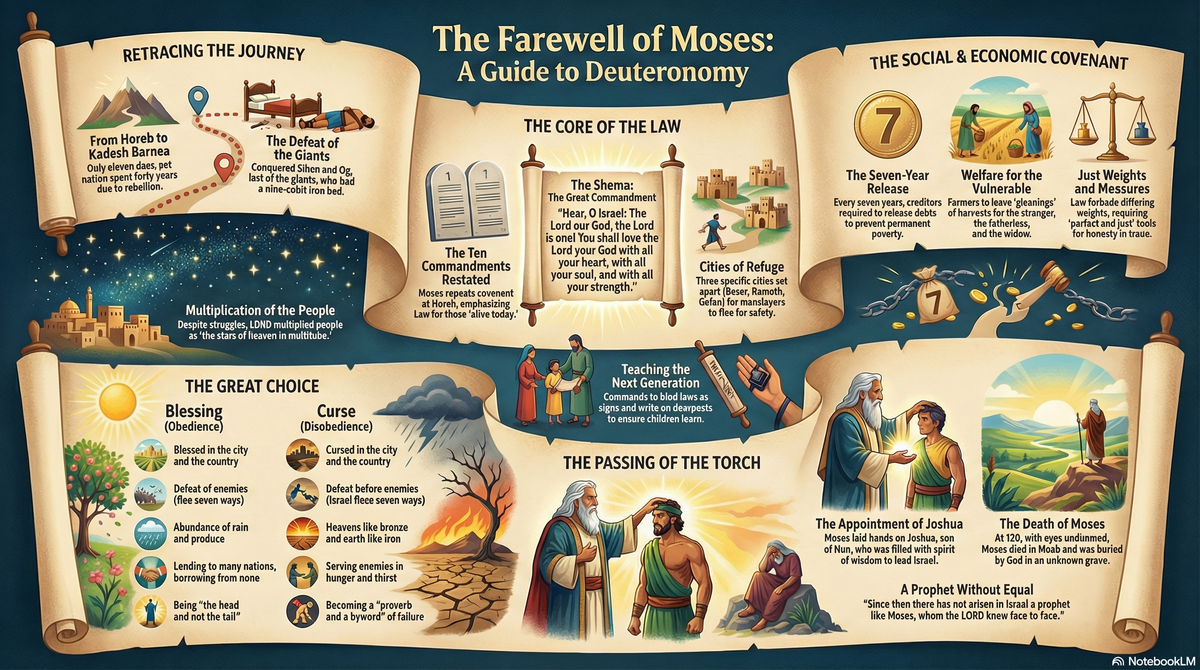
\Deuteronomy, the fifth and final book of the Pentateuch (Torah), is presented as a series of farewell speeches delivered by Moses to the new generation of Israel on the plains of Moab, just before they cross the Jordan River into the Promised Land.
The name “Deuteronomy” means “second law” (from Greek), reflecting its role as a restatement, renewal, and application of the covenant laws given at Sinai forty years earlier.
Traditionally attributed to Moses (with a brief epilogue possibly added later), the book covers events in a single location and time frame—approximately one month in the fortieth year after the exodus.
It combines exhortation, historical review, covenant renewal, laws adapted for settled life in Canaan, blessings and curses, and Moses’ final charge and death. Deuteronomy serves as a theological constitution for Israel, emphasizing heartfelt obedience, covenant loyalty, and the choice between life and death.
Overall Theme:
The overarching theme of Deuteronomy is covenant love and faithful obedience to the one true God. Moses repeatedly calls Israel to “love the LORD your God with all your heart, with all your soul, and with all your strength” (6:5)—the greatest commandment, later quoted by Jesus (Mark 12:29–30).
The book presents the covenant not merely as rules but as a gracious relationship initiated by God’s electing love and redemption from Egypt. Israel is urged to respond with wholehearted devotion, remembering God’s past faithfulness, fearing Him, keeping His commands, and teaching them diligently to future generations.
Deuteronomy contrasts blessing for covenant obedience (life, prosperity, possession of the land) with curse for disobedience (exile, destruction), yet holds out hope through God’s mercy and promise to circumcise hearts (30:6).
It stresses monotheism (“Hear, O Israel: The LORD our God, the LORD is one,” 6:4), social justice, care for the vulnerable, and worship centered on God alone, warning against idolatry that would lead to losing the land.
Deuteronomy is both retrospective (recalling God’s acts) and prospective (preparing for life in Canaan), pointing forward to the need for a new heart that only the Messiah can provide.
Location Settings:
Plains of Moab / east of the Jordan opposite Jericho — The sole setting of the entire book. Israel is encamped here in the final stage of the wilderness journey, overlooking the Promised Land but not yet entering it.
- Beth Peor — Mentioned as a specific site near where Moses speaks and is later buried.
- Mount Nebo / Pisgah — Moses climbs here to view the land; he dies and is buried by God in an unknown place in Moab.No travel narrative occurs; the focus remains stationary on the plains, with Moses addressing the people from this vantage point as they prepare to cross into Canaan under Joshua’s leadership. The geographical contrast is poignant: Israel stands on the threshold of promise, looking across the Jordan at the land flowing with milk and honey.
People Involved:
God (the LORD / Yahweh):
The central figure; covenant-making, redeeming, law-giving, blessing, and judging God who loves Israel and demands exclusive loyalty.
Moses:
Aging leader (120 years old); delivers the speeches, reviews history, renews the covenant, appoints Joshua, and dies without entering Canaan.
The Israelites (children of Israel / new generation):
Descendants of those who left Egypt; the wilderness generation that perished has died off; this new generation stands ready to inherit the land but must choose obedience.
Joshua:
Moses’ successor; commissioned to lead Israel into Canaan; present as Moses speaks.
The elders, officers, judges, and tribal heads:
Addressed as leaders responsible for teaching and administering justice.
Supporting figures / groups:
- Caleb — Briefly recalled as one of the faithful spies.
- The Levites — Responsible for carrying the ark, teaching the law, and pronouncing blessings/curses.
- Foreign nations (Canaanites, Amorites, etc.) — Warnings against intermingling or adopting their practices.
- The vulnerable (widows, orphans, sojourners, Levites, poor) — Frequently mentioned as objects of Israel’s justice and generosity
Detailed Chapter Summary:
Chapters 1–4 – Historical review and exhortation
Moses recounts the journey from Horeb (Sinai): appointment of judges, sending of spies, rebellion at Kadesh, forty years of wandering, defeat of Sihon and Og, and allocation of land east of the Jordan. He urges obedience, warns against idolatry, and reminds Israel of God’s unique revelation at Sinai.
Chapters 5–11 – The Ten Commandments and the great commandment
Restatement of the Decalogue (ch. 5). The Shema (6:4–9) and command to love God wholly; teach children diligently. Warnings against forgetting God in prosperity; call to destroy Canaanite altars and not intermarry. Recalls the golden calf and God’s mercy; exhortation to circumcise hearts and fear the LORD.
Chapters 12–26 – The Deuteronomic Code (laws for life in the land)
Centralized worship at “the place the LORD will choose” (ch. 12); warnings against false prophets and idolatry (chs. 13–18). Laws on clean/unclean foods, tithes, debt cancellation every seven years, release of slaves, justice, kingship (limited monarchy), priests/Levites, false witnesses, warfare, unsolved murders, family laws, honest weights, firstfruits, and festivals. Strong emphasis on justice, compassion for the poor, and care for sojourners, widows, orphans.
Chapters 27–30 – Covenant renewal: blessings and curses
Instructions for covenant ceremony on Mounts Ebal and Gerizim: curses pronounced by Levites for secret sins, blessings for obedience. Moses sets before Israel life and death, blessing and curse; urges them to choose life by loving and obeying God. Promise of restoration even after exile if Israel returns to God; prediction of heart circumcision.
Chapters 31–34 – Moses’ final acts and death
Moses commissions Joshua, writes the law, entrusts it to the Levites to read every seven years at the Feast of Tabernacles. Song of Moses (ch. 32) and blessing on the tribes (ch. 33). Moses ascends Mount Nebo, views the land, dies; God buries him. Epilogue praises Moses’ unique relationship with God.
Closing Prayer:
Merciful and faithful God, who chose Israel not because of their greatness but because of Your love and Your oath to the fathers, we thank You for the book of Deuteronomy that calls us to love You with all our heart, soul, and strength. In Moses’ final words, we hear the urgency of covenant loyalty, the danger of forgetting You amid blessing, and the hope of Your restoring grace even after failure.
Thank You for the greater Prophet like Moses—Jesus Christ—who perfectly loved You, fulfilled the law, and circumcises hearts by Your Spirit. Help us choose life daily, teach Your commands to our children, and walk humbly before You in justice, mercy, and wholehearted devotion until we enter the eternal rest You have promised. To You, the only God, be glory forever. Amen.