The First Book of the Chronicles: Genealogies, David's Reign, and Temple Preparations
Comprehensive overview of 1 Chronicles — extensive genealogies affirming Israel's identity, the positive portrayal of David's kingship, his devotion to worship, preparations for the temple, and God's eternal covenant with David's house.
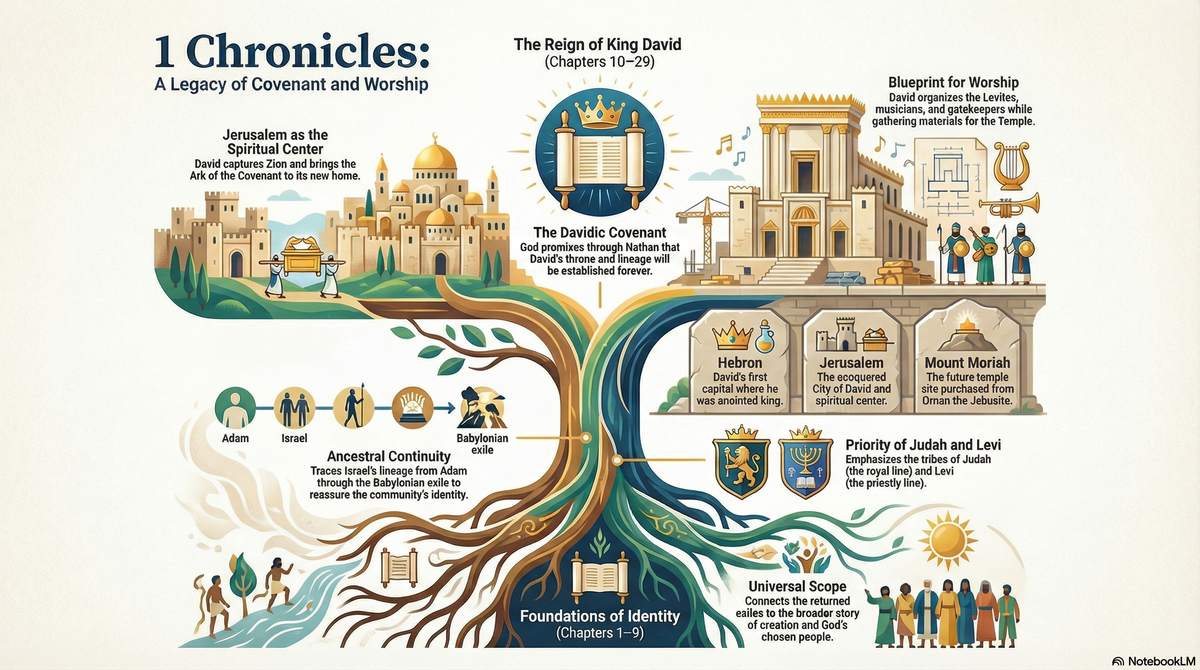
The First Book of the Chronicles (commonly called 1 Chronicles) is a historical and theological retelling of Israel's story, beginning with extensive genealogies from Adam to the post-exilic period and then focusing on the reign of King David.
Written from a priestly perspective, likely during or after the Babylonian exile (c. 5th–4th century BC), it serves as a companion to 2 Chronicles (together forming Chronicles). The book emphasizes God's covenant with David, the centrality of worship centered at the Jerusalem temple, and the continuity of God's people despite exile.
Traditionally attributed to Ezra or a chronicler in the post-exilic community, 1 Chronicles covers from creation (through genealogies) to David's death (c. 1010 BC), but its purpose is not merely historical—it is to encourage the returned exiles by reminding them of their identity, David's legacy, and the importance of proper worship. The book divides into two main parts: genealogies (chs. 1–9) and the narrative of David's reign (chs. 10–29).
Overall Theme:
The overarching theme of 1 Chronicles is God's unchanging covenant faithfulness to His people through the line of David and the centrality of worship in the temple. Unlike Samuel–Kings, which focus on the failures of kings and the causes of exile, Chronicles presents a more positive, restorative portrait, highlighting David's devotion to God, his preparations for the temple, and his organization of worship.
The genealogies establish the continuity of God's chosen people from Adam through the tribes (especially Judah and Levi) to the post-exilic community. David is portrayed as the ideal king—pious, a man after God's heart—who prioritizes worship, gathers materials for the temple, and organizes priests, Levites, musicians, gatekeepers, and officials.
The book underscores that true blessing comes from seeking the LORD wholeheartedly, maintaining proper worship, and trusting God's promises. It reassures the returned exiles that God's covenant with David remains valid, pointing forward to the ultimate Davidic King, the Messiah, whose kingdom and temple worship will endure forever.
Location Settings
Genealogical section (chs. 1–9):
- Universal and tribal scope with minimal specific geography. Locations mentioned include Eden (implied), Canaan broadly, Egypt (briefly for Joseph), and various tribal territories in the Promised Land (Judah, Simeon, Reuben, Gad, etc.).
- Post-exilic settlements around Jerusalem (ch. 9), especially for returning families of Judah, Benjamin, and Levites.
David's reign (chs. 10–29):
- Jabesh-gilead — Where Saul's body is buried after his death (ch. 10).
- Hebron — David's first capital; anointed king over Judah and later all Israel (ch. 11).
- Jerusalem (City of David / Zion) — Primary setting after conquest from Jebusites (ch. 11); becomes political and spiritual center. David brings the ark here (ch. 13, 15–16), builds an altar, and plans the temple.
- Various battlefields — Baal-perazim, valley of Rephaim (Philistines), Rabbah (Ammonites), and other sites of David's victories.
- Mount Moriah — Identified as the future temple site; David purchases Ornan's (Araunah's) threshing floor and builds an altar there after the census plague (ch. 21).The focus narrows to Jerusalem as the divinely chosen place for worship and the Davidic dynasty.
People Involved
God (the LORD / Yahweh):
Sovereign over history; faithful to His covenant with David; delights in worship; judges sin but shows mercy.
David:
Central human figure; anointed king, mighty warrior, worshiper; organizes temple preparations, Levites, musicians; man after God's heart who seeks the LORD.
Saul:
Briefly mentioned; his death and the transfer of the kingdom to David (ch. 10).
The tribes of Israel:
Especially Judah (David's tribe), Levi (priests and temple servants), and Benjamin (Saul's tribe).
Key supporting figures:
- Jesse — David's father.
- The mighty men (e.g., Jashobeam, Eleazar, Abishai, Benaiah) — David's warriors and loyal supporters.
- Jonathan — Saul's son; covenant friendship with David recalled.
- Uzzah — Struck dead for touching the ark (ch. 13).
- Nathan — Prophet who delivers covenant promise (ch. 17).
- Gad — Prophet who warns David after census (ch. 21).
- Ornan (Araunah) the Jebusite — Sells threshing floor for altar/temple site.
- Solomon — David's son; designated as temple builder and successor (chs. 22–29).
- Zadok and Abiathar — Priests during David's reign.
- Levites, priests, singers, gatekeepers — Organized by David for temple service.
Detailed Chapter Summary:
Chapters 1–9 – Genealogies from Adam to post-exileAdam to Noah; Noah's sons; Abraham's line through Isaac, Jacob/Israel. Detailed tribal genealogies: Judah (to David), Simeon, Reuben, Gad, Manasseh (half east of Jordan), Levi (priests and Levites with cities), Issachar, Benjamin, Naphtali, Manasseh (west), Ephraim, Asher. Post-exilic inhabitants of Jerusalem listed (ch. 9).
Chapter 10 – Death of SaulSaul and sons die at Mount Gilboa; body desecrated; men of Jabesh-gilead bury remains. Kingdom transferred to David.
Chapters 11–12 – David's rise and mighty menDavid anointed in Hebron; captures Jerusalem. List of mighty men and their exploits. Warriors from tribes join David at Ziklag and Hebron.
Chapters 13–16 – The ark brought to JerusalemUzzah dies touching ark; David fears, later brings it successfully with rejoicing, music, sacrifices. David dances; appoints Levites as singers and musicians; psalm of thanksgiving.
Chapter 17 – The Davidic covenantDavid desires to build temple; Nathan delivers God's promise: David's son will build it; David's throne established forever. David's prayer of gratitude.
Chapters 18–20 – David's victoriesConquests over Philistines, Moab, Zobah, Aram, Edom, Ammon. Joab captures Rabbah; David takes crown.
Chapter 21 – Census and plagueDavid numbers Israel; sin brings judgment. Gad instructs altar on Ornan's threshing floor; plague stops.
Chapters 22–26 – David's temple preparationsDavid charges Solomon to build temple; gathers materials, organizes Levites, priests, musicians, gatekeepers, officials, treasurers.
Chapters 27–29 – Final preparations and deathMilitary divisions, tribal leaders, stewards. David assembles leaders; gives Solomon plans, materials; exhorts obedience. People's generous offerings. David's prayer; Solomon anointed; David dies "in a good old age, full of days, riches, and honor."
Closing Prayer:
Faithful God, who promised David an everlasting throne and preserved Your people through generations, we thank You for the book of 1 Chronicles that reminds us of Your covenant love and the priority of worshiping You rightly. In the long line from Adam to David, and in David's heart for Your house, we see Your sovereign plan unfolding across history.
Thank You for portraying David not as perfect but as devoted, preparing the way for the temple and pointing to the greater Son of David, Jesus Christ, who is the true temple and eternal King. Help us, like the returned exiles, to seek You wholeheartedly, to value Your presence above all, and to live as Your covenant people until we join the worship around Your throne forever. To You be glory and praise. Amen.
Try Pastor Mugs App
Your KJV Pocket Companion. Faithful insights, verse clarity, guided prayers—ready whenever you open the Word.
Start Free, no strings ->