The First Book of the Kings
Comprehensive overview of 1 Kings — Solomon's wisdom and temple, the tragic split into Israel and Judah, early kings' failures, and Elijah's prophetic confrontations against idolatry, illustrating covenant consequences.
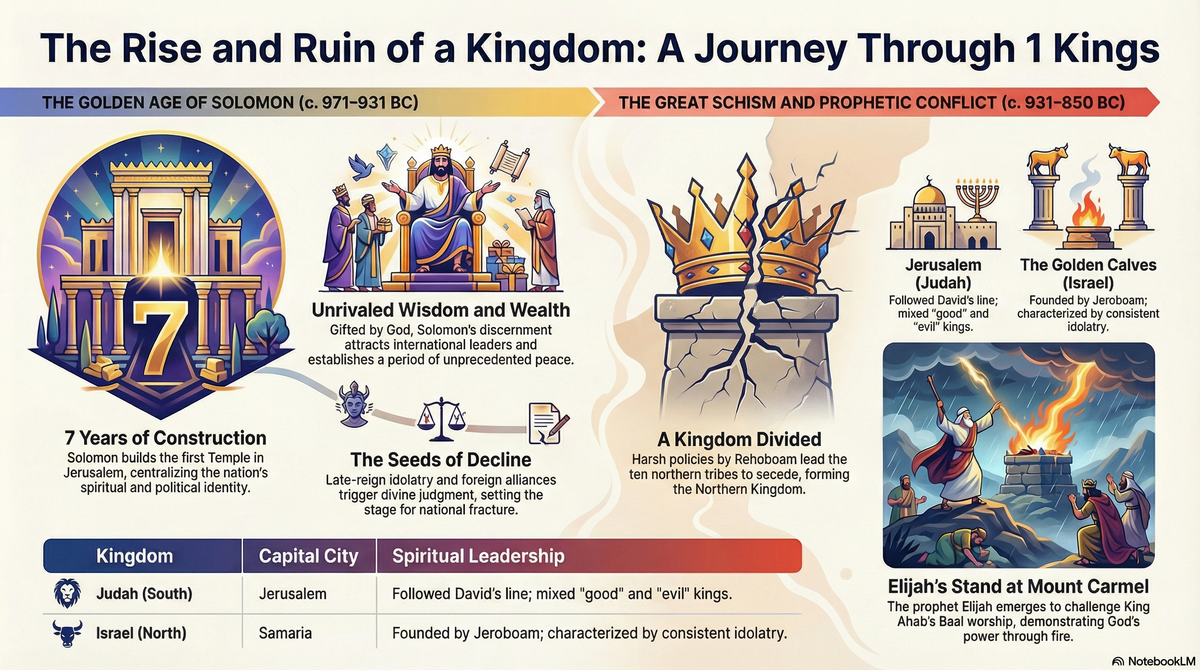
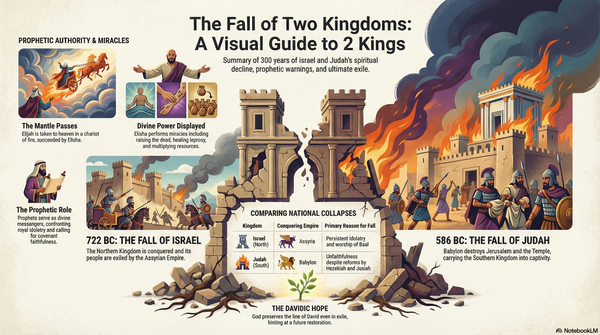
The First Book of the Kings (also known as 1 Kings, or in some traditions the Third Book of the Kings) continues the royal history from 2 Samuel, detailing the end of David's reign, the glorious but flawed kingship of Solomon, the tragic division of the united kingdom into Israel (north) and Judah (south), and the early reigns of kings in both kingdoms, highlighted by the prophetic ministry of Elijah. Traditionally part of the Deuteronomistic history (possibly compiled by prophetic figures or editors around the exile), the book covers approximately 120 years (c. 971–850 BC). It divides into three major sections: the transition to Solomon and his reign (chs. 1–11), the division of the kingdom and early kings (chs. 12–16), and the reigns of Ahab in Israel and Asa/Jehoshaphat in Judah with Elijah's confrontations (chs. 17–22). 1 Kings explains why Israel's prosperity under Solomon gave way to idolatry, division, and judgment, emphasizing obedience to God's covenant as the key to blessing.
Overall Theme:
The overarching theme of 1 Kings is the consequences of covenant faithfulness or unfaithfulness under kingship. God remains sovereign over Israel's history, blessing obedience (Solomon's early wisdom and temple) and judging disobedience (Solomon's idolatry, Jeroboam's calves, Ahab's Baal worship). The book evaluates kings by whether they walked in David's ways or turned to idols, with the refrain that they "did evil in the sight of the LORD" or "did right." Solomon's reign peaks with temple dedication and international fame but falls through foreign wives and high places. The division fulfills God's judgment yet preserves Judah for David's line. Elijah's ministry shows God's power over Baal and call to exclusive worship. 1 Kings warns that rejecting the LORD leads to national decline, while true devotion brings blessing—pointing to the need for a perfect king in the line of David (fulfilled in Christ).
Location Settings:
Jerusalem — Dominant setting; David's capital, site of Solomon's anointing, palace, and temple construction/dedication (chs. 1–11). Central religious and political hub for Judah.
Gibeon — High place where Solomon receives wisdom in a dream (ch. 3); early sacrificial site.
Various building sites — Solomon's projects: temple in Jerusalem, palace complex, fortifications at Hazor, Megiddo, Gezer (ch. 9).
Shechem — Site of Rehoboam's assembly and kingdom division (ch. 12).
Bethel and Dan — Northern kingdom's golden calf shrines established by Jeroboam (ch. 12).
Mount Carmel — Dramatic confrontation between Elijah and Baal prophets (ch. 18).
Zarephath (Sidon) — Elijah's widow miracle (ch. 17).
Samaria — Capital of northern Israel under Omri and Ahab (chs. 16–22).
Jezreel — Ahab's palace; Naboth's vineyard (ch. 21).
Brook Cherith and wilderness — Elijah's hiding and provision (ch. 17).The narrative shifts from unified Jerusalem-centered glory to divided kingdoms, with northern sites (Samaria, Bethel) contrasting southern Jerusalem.
People Involved
God (the LORD / Yahweh):
Sovereign over kings and nations; grants wisdom, judges idolatry, sends prophets, demonstrates power over Baal.
David:
Aging king; final instructions and death; his throne promised eternally.
Solomon:
David's son; wise king who builds temple; prays for discernment; prospers but turns to idolatry via foreign wives.
Adonijah:
David's son; attempts to seize throne; executed.
Bathsheba:
Solomon's mother; advocates for his kingship.
Nathan:
Prophet; anoints Solomon, confronts David earlier (referenced).
Zadok:
Priest; anoints Solomon.
Rehoboam:
Solomon's son; foolish policies cause division; king of Judah.
Jeroboam:
Ephraimite official; rebels, becomes first king of northern Israel; sets up calves.
Elijah:
Powerful prophet; confronts Ahab, performs miracles, defeats Baal prophets on Carmel.
Ahab:
King of Israel; marries Jezebel; promotes Baal worship; wicked but repents temporarily.
Jezebel:
Ahab's Phoenician wife; promotes Baal, kills prophets, schemes for Naboth's vineyard.
Asa:
King of Judah; does right, removes idols.
Jehoshaphat:
Asa's son; godly king of Judah.
Supporting figures:
Abishag (David's attendant), Joab (executed), Shimei (cursed), Hiram of Tyre (temple supplier), Queen of Sheba (visits Solomon), Naboth (vineyard owner), Micaiah (true prophet), Ben-Hadad (Aram king).
Detailed Chapter Summary
Chapters 1–2 – Solomon's accession
David old; Adonijah proclaims himself king. Nathan and Bathsheba secure Solomon's anointing at Gihon. David charges Solomon to obey God; dies. Solomon eliminates threats (Adonijah, Joab, Shimei); throne established.
Chapters 3–4 – Solomon's wisdom and prosperity
Solomon asks for understanding heart at Gibeon; God grants wisdom, riches, honor. Famous judgment of two mothers' child. Officials, provisions, vast kingdom described.
Chapters 5–8 – Temple construction and dedication
Alliance with Hiram for materials. Temple built (7 years); detailed dimensions, furnishings. Ark brought in; God's glory fills house. Solomon's long prayer of dedication; sacrifices; festival.
Chapters 9–11 – Solomon's later years and decline
God appears; warns of obedience. Solomon's building projects, cities. Queen of Sheba visits; marvels at wisdom. Solomon's foreign wives turn his heart to idols; high places built. God raises adversaries (Hadad, Rezon, Jeroboam); tears kingdom but spares Judah for David.
Chapters 12–14 – Kingdom division
Rehoboam rejects elders' advice; heavy yoke. Northern tribes rebel; Jeroboam king of Israel. Jeroboam sets calves at Bethel/Dan; prophet warns; hand withers, restored. Ahijah prophesies against Jeroboam's house; child dies. Rehoboam in Judah; evil reigns.
Chapters 15–16 – Kings of Judah and Israel
Abijam, Asa (good, reforms) in Judah. Nadab, Baasha, Elah, Zimri, Omri (builds Samaria), Ahab (most wicked) in Israel. Brief reigns, idolatry.
Chapters 17–19 – Elijah's ministry
Elijah prophesies drought; fed by ravens, widow at Zarephath (meal/flour, son raised). Contest on Carmel: fire consumes offering; Baal prophets slain. Jezebel threatens; Elijah flees to Horeb; God speaks in still small voice; commissions Elisha.
Chapters 20–22 – Ahab's wars and death
Ben-Hadad besieges Samaria; Israel defeats twice. Ahab spares him. Naboth's vineyard; Jezebel schemes murder. Elijah confronts Ahab; doom pronounced. Micaiah prophesies Ahab's death; Ahab killed in battle at Ramoth Gilead.
Closing Prayer
Sovereign God, who established David's throne and promised an enduring dynasty, we thank You for the book of 1 Kings that reveals the heights of blessing under obedient leadership and the depths of judgment when kings and people turn from You.
In Solomon's wisdom and temple, we see the glory of Your presence among Your people; in the division, idolatry, and Elijah's stand, we see the peril of divided hearts. Thank You for Your faithfulness despite human failure, preserving a remnant and pointing to the greater King, Jesus Christ, the wise Son of David who builds Your eternal temple—the church—and reigns in perfect righteousness.
Grant us undivided devotion, courage like Elijah's to confront compromise, and trust in Your sovereign plan until every knee bows to Your Son. To You be glory forever. Amen.
Try Pastor Mugs App
Your KJV Pocket Companion. Faithful insights, verse clarity, guided prayers—ready whenever you open the Word.
Start Free, no strings ->