The Fourth Book of Moses: Called Numbers
Comprehensive overview of Israel’s wilderness wanderings — from the census and organization at Sinai, through rebellion, judgment and wandering
Summary
Numbers, the fourth book of the Pentateuch, derives its English name from the two censuses of Israel (chs. 1 and 26). In Hebrew it is called “In the Wilderness” (Bemidbar), accurately reflecting its content.
The book bridges the revelation at Sinai (Leviticus) and the conquest of Canaan (Joshua), narrating Israel’s forty-year wilderness period. It begins with the organization of the camp and tabernacle service at Sinai, records repeated acts of rebellion leading to judgment, includes key episodes like the spies’ report, Korah’s revolt, and Balaam’s oracles, and concludes with preparations for entering the Promised Land.
Traditionally attributed to Moses, Numbers combines census data, laws, genealogies, itineraries, and dramatic narrative, covering roughly thirty-eight years of wandering after the initial refusal to enter Canaan.
Overall Theme:
The overarching theme of Numbers is God’s unwavering faithfulness in the face of persistent unbelief and rebellion. Though Israel is redeemed and covenanted at Sinai, the book reveals the depth of human sinfulness through grumbling, idolatry, rebellion against God’s appointed leaders, and lack of faith in His promises.
God responds with righteous judgment (plagues, fire, earth swallowing rebels, serpents), yet repeatedly shows mercy through intercession (especially Moses’), provision (manna, water, guidance), and preservation of a remnant.
Numbers emphasizes God’s holiness, the necessity of obedience, the consequences of unbelief (the older generation dies in the wilderness), and His commitment to fulfill the covenant promises despite Israel’s failures. The transition to a new generation and Joshua’s emergence foreshadow hope and the eventual inheritance of the land.
Location Settings:
Mount Sinai (Horeb) — Opening chapters (1–10); Israel remains encamped here for about a year after the Tabernacle’s erection, organized by tribes around the sanctuary.
The Wilderness of Paran / Zin / various wilderness regions — Primary setting for most of the book (chs. 11–21, 33). Key locations include:
- Taberah, Kibroth-hattaavah — Sites of fire and quail judgment.
- Kadesh-barnea — Central hub in the wilderness of Paran/Zin; where the spies are sent and the major rebellion occurs (chs. 13–14); Israel wanders from here for decades.
- Edom, Moab, Ammon territories — Later wanderings skirt these nations; encounters with Edomites, Amorites (Sihon and Og defeated).
- Plains of Moab — Final major setting (chs. 22–36); east of the Jordan opposite Jericho; where Balaam is hired, second census taken, laws given, and preparations made to cross into Canaan.
The book traces a long, circuitous journey from Sinai southward, eastward, then northward, mostly in desolate desert regions.
People Involved:
God (the LORD / Yahweh):
Faithful, holy, patient, yet jealous for His glory; provides, judges, forgives, and guides with cloud and fire.
Moses:
God’s servant and mediator; leads, intercedes, suffers frustration, yet remains faithful; his authority repeatedly challenged.
Aaron:
High priest; shares leadership with Moses; dies on Mount Hor.
Miriam:
Prophetess; rebels against Moses and is struck with leprosy temporarily.
Joshua:
Moses’ assistant; one of two faithful spies; emerges as successor.
Caleb:
Faithful spy from Judah; promised inheritance alongside Joshua.
The twelve spies (and the congregation):
Ten bring evil report leading to rebellion; the people weep and refuse to enter the land.
Korah, Dathan, Abiram, and 250 leaders:
Rebels against Moses and Aaron; swallowed by the earth or consumed by fire.
Eleazar:
Aaron’s son; succeeds as high priest.
Phinehas:
Eleazar’s son; zealous priest who stops a plague by executing idolaters.
Balaam:
Gentile prophet hired by Balak to curse Israel; forced by God to bless instead.
Balak:
King of Moab; fears Israel and seeks to curse them.
The Israelites:
Grumbling, idolatrous, faithless older generation perishes; new generation prepared for conquest.
Detailed Chapter Summary:
Chapters 1–4 – Census and camp organization
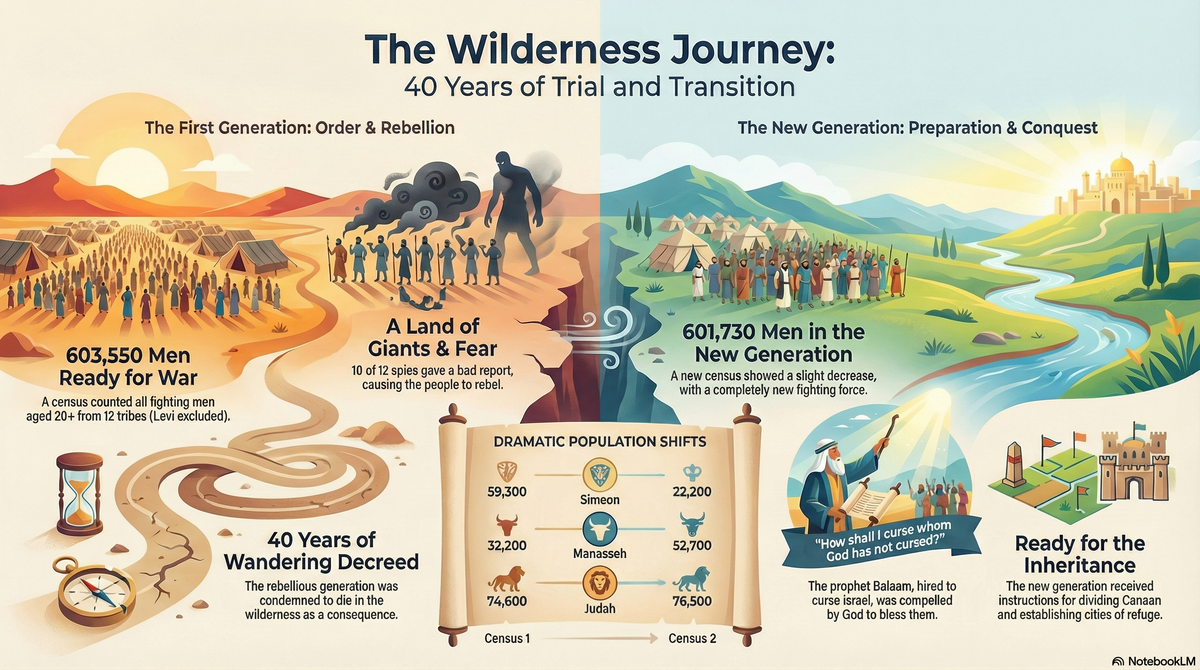
First census of fighting men (603,550); tribes arranged around the Tabernacle. Duties of Levites (Kohathites, Gershonites, Merarites) in transporting the sanctuary.
Chapters 5–10 – Purity laws, Nazirite vow, priestly blessing, final preparations
Cleansing from defilement, restitution, jealousy ordeal, Nazirite regulations, Aaronic blessing. Trumpets made; cloud/fire guide departure from Sinai.
Chapters 11–12 – Early rebellions
People complain; fire consumes outskirts; quail judgment at Kibroth-hattaavah. Miriam and Aaron challenge Moses; Miriam struck with leprosy.
Chapters 13–14 – Spies and the great rebellion
Twelve spies sent from Kadesh; ten give fearful report; people refuse to enter Canaan. God decrees forty years of wandering; older generation to die in wilderness. Attempted invasion fails.
Chapters 15–19 – Supplementary laws and Korah’s revolt
Laws on offerings, tassels, Sabbath-breaker stoned. Korah, Dathan, Abiram rebel; earth swallows them; fire consumes 250; plague follows; Aaron’s rod buds.
Chapters 20–21 – Water from rock, Aaron’s death, victories
Moses strikes rock instead of speaking; barred from Canaan. Aaron dies on Mount Hor. Bronze serpent raised for healing from fiery serpents. Victories over Arad, Sihon, Og.
Chapters 22–24 – Balaam and Balak
Balak hires Balaam to curse Israel; God forces blessings instead. Four oracles pronounce blessing and future dominion.
Chapters 25–27 – Baal Peor idolatry, second census, succession
Phinehas kills idolaters; plague stopped. Second census (601,730 fighting men). Joshua commissioned as Moses’ successor.
Chapters 28–30 – Offerings and vows
Calendar of daily, Sabbath, monthly, and festival offerings. Regulations on vows.
Chapters 31–36 – Vengeance on Midian, land allocation, inheritance laws
War against Midian; purification of spoils. Reuben, Gad, half-Manasseh request land east of Jordan; granted with condition. Cities of refuge, Levitical cities, inheritance for daughters (Zelophehad’s case).
Closing Prayer:
Faithful God, who led Your people with cloud by day and fire by night, yet saw their hearts turn in unbelief and rebellion, we thank You for the book of Numbers that reveals both the cost of disobedience and the depth of Your mercy.
In the wilderness wanderings, we see our own grumbling hearts, yet also Your patient provision, Your zealous protection of holiness, and Your unchanging promise to bring Your people into rest.
Thank You for raising up faithful mediators like Moses and ultimately the greater Mediator, Jesus Christ, who bore the curse of our rebellion. Grant us faith to trust Your promises, courage to follow where You lead, and gratitude for Your steadfast love that endures to all generations. To You be glory forever and ever. Amen.