The Second Book of Moses: Called Exodus
Comprehensive overview of Israel’s deliverance from Egyptian slavery, God’s covenant at Sinai, the giving of the Law, the Tabernacle instructions, and the establishment of Israel as God’s chosen nation — a foundational story of redemption, covenant relationship, and divine presence among His people.
Summary
Exodus, the second book of the Bible, continues directly from Genesis, moving from the family of Jacob to the birth of the nation of Israel. It chronicles the dramatic deliverance of the Israelites from centuries of slavery in Egypt, their miraculous journey through the wilderness, the solemn covenant established at Mount Sinai, and the detailed instructions for building the Tabernacle as the place of God’s dwelling among His people. Traditionally attributed to Moses, Exodus covers roughly 430 years from the death of Joseph to the construction of the Tabernacle (though the main events occur within a single year). The book divides into three major sections: deliverance from Egypt (chs. 1–18), covenant and Law at Sinai (chs. 19–24), and the Tabernacle (chs. 25–40).
Overall Theme:
The overarching theme of Exodus is God’s mighty redemption of His people and His desire to dwell among them in covenant relationship. God hears the cries of enslaved Israel, remembers His covenant with Abraham, Isaac, and Jacob, and delivers them with powerful acts of judgment on Egypt and salvation through the Passover and Red Sea. At Sinai, He reveals His holy character, gives the Law as the foundation of their national life, and establishes the Tabernacle so that His presence may go with them. Exodus contrasts God’s faithfulness with Israel’s frequent unbelief and rebellion, yet He remains the covenant-keeping God who forgives and restores. The book reveals God’s name “I AM WHO I AM” (Yahweh), His supremacy over all powers, and His purpose to make Israel “a kingdom of priests and a holy nation” (19:6) for the blessing of the world.
Location Settings:
Egypt — Primary setting for the first half (chs. 1–15). The Israelites are enslaved in the Nile Delta region (Goshen and surrounding areas). Key events: oppression, Moses’ confrontation with Pharaoh, the ten plagues, Passover, and the exodus from Rameses.
The Wilderness (Sinai Peninsula) — Central for the journey and Sinai events (chs. 16–19, 24, 32–34). Key locations include:
- Marah (bitter waters made sweet)
- Elim (oasis with springs and palms)
- Wilderness of Sin (manna and quail given)
- Rephidim (water from the rock; battle with Amalek)
- Mount Sinai (Horeb) — The mountain of God where the covenant is made, the Law given, and God appears in fire, thunder, and cloud.
The Tabernacle — Constructed at the foot of Sinai and becomes the portable sanctuary that travels with Israel.
The narrative moves from the fertile Nile to the harsh wilderness, symbolizing transition from bondage to freedom and from oppression to covenant intimacy with God.
People Involved
God (Yahweh / the LORD):
Reveals His name “I AM” (3:14); sovereign over nature, nations, and history; delivers, judges, forgives, and dwells with His people.
Moses:
Central human figure; reluctant deliverer raised in Pharaoh’s court, called at the burning bush, mediator of the covenant, lawgiver, intercessor for rebellious Israel.
Aaron:
Moses’ brother; first high priest, spokesman for Moses, yet involved in the golden calf sin.
Miriam:
Moses’ sister; prophetess who leads worship after the Red Sea crossing.
Pharaoh (likely Ramses II or a contemporary):
Hardened king who refuses to let Israel go, suffers the ten plagues, ultimately pursues Israel to the Red Sea.
The Israelites:
Descendants of Jacob; enslaved people who groan under bondage, witness miracles, receive the Law, and repeatedly grumble and rebel.
Jethro:
Moses’ father-in-law, Midianite priest; advises Moses on leadership and offers sacrifice to God.
Joshua:
Moses’ young assistant; leads battle against Amalek; later successor.
Bezalel and Oholiab:
Skilled craftsmen filled with the Spirit to build the Tabernacle and its furnishings.
Supporting figures:
The Hebrew midwives (Shiphrah and Puah), Pharaoh’s daughter (who rescues Moses), the elders of Israel, the rebellious Korah (mentioned briefly), and the Amalekites.
Detailed Chapter Summary
Chapters 1–2 – Oppression and the birth of Moses
Israel multiplies in Egypt but is enslaved. Pharaoh orders male infants killed. Moses is born, hidden, rescued by Pharaoh’s daughter, raised in the palace. As an adult, he kills an Egyptian taskmaster, flees to Midian, marries Zipporah, and has a son (Gershom).
Chapters 3–4 – The burning bush and call of Moses
God appears to Moses in the burning bush, reveals His name Yahweh (“I AM”), commissions him to deliver Israel. Moses objects; God provides signs and Aaron as helper.
Chapters 5–11 – Confrontation and the ten plagues
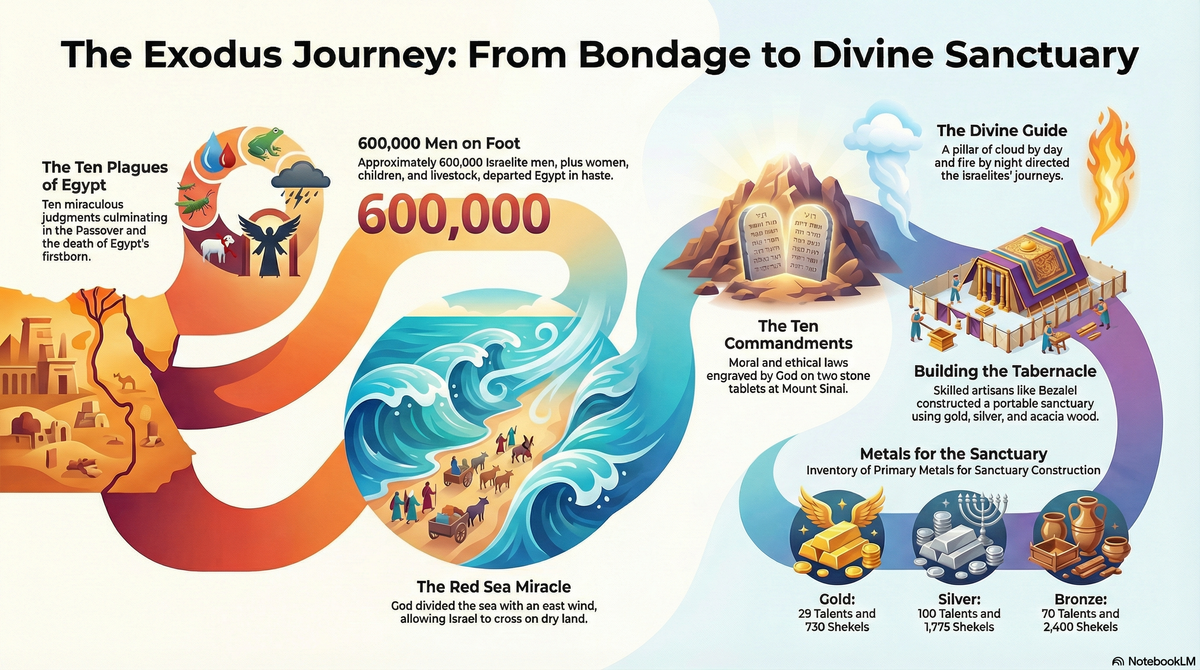
Moses and Aaron demand release; Pharaoh hardens his heart. God sends plagues: water to blood, frogs, lice, flies, livestock disease, boils, hail, locusts, darkness, and death of the firstborn.
Chapter 12 – The Passover and exodus
Instructions for the Passover lamb; blood on doorposts protects from death angel. Firstborn of Egypt struck; Pharaoh expels Israel. They leave with great possessions.
Chapter 13–15 – Red Sea crossing and song of victory
God leads by pillar of cloud/fire. Pharaoh pursues; waters part; Israel crosses on dry ground. Egyptians drowned. Moses and Miriam sing songs of deliverance.
Chapters 16–18 – Wilderness provision and leadership
Manna and quail provided; water from rock at Rephidim. Battle with Amalek (Joshua leads). Jethro advises Moses to appoint judges.
Chapters 19–24 – Covenant at Sinai
Israel camps at Sinai. God descends in fire; gives Ten Commandments (20:1–17). Israel fears; asks Moses to mediate. Covenant ratified with blood; instructions for worship and justice (Book of the Covenant).
Chapters 25–31 – Tabernacle instructions
Detailed plans for the Tabernacle, ark, mercy seat, table, lampstand, altar, courtyard, priests’ garments, and consecration. Bezalel and Oholiab appointed.
Chapters 32–34 – The golden calf and covenant renewal
Israel worships golden calf; Moses intercedes; tablets broken. God forgives; renews covenant; shows Moses His glory; new tablets made.
Chapters 35–40 – Tabernacle construction and God’s glory
People bring offerings willingly. Tabernacle built exactly as commanded. Moses inspects; God’s glory fills the Tabernacle.
Closing Prayer
Almighty God, who heard the cries of Your suffering people in Egypt and delivered them with a mighty hand and outstretched arm, we thank You for the book of Exodus that reveals Your redeeming power, Your holy name, and Your desire to dwell among Your people. In the Passover lamb and the parted sea, we see the foreshadowing of Christ our Redeemer. Grant us faith to trust Your deliverance, obedience to Your commands, and reverence for Your holy presence. May we, like Israel, be a kingdom of priests who reflect Your glory until the day we see You face to face in the new creation. To You, the great I AM, be honor and praise forever. Amen.