The Second Book of Samuel: David's Reign, Covenant, and Decline
Complete overview of 2 Samuel — David's kingship, conquests, adultery and repentance, Absalom's rebellion, and God's eternal covenant promising the Messianic line.
Summary
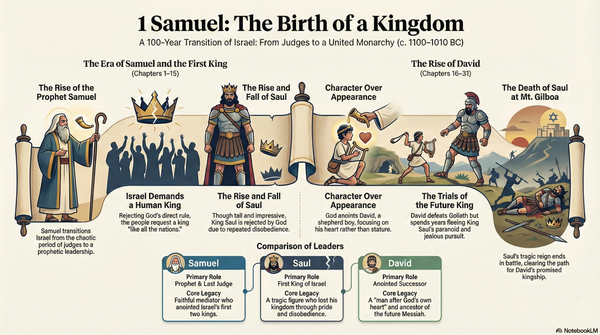
The Second Book of Samuel (also known in some traditions as the Second Book of the Kings) continues the narrative from 1 Samuel, focusing on the reign of David as king over all Israel. It begins with David's mourning for Saul and Jonathan, his anointing as king of Judah, and eventual unification of the kingdom after Ishbosheth's death. The book details David's military conquests, establishment of Jerusalem as capital, bringing the ark there, God's covenant promising an eternal dynasty, and his personal triumphs and tragedies—including adultery with Bathsheba, murder of Uriah, family strife with Absalom's rebellion, and later census leading to plague. Traditionally attributed to the same prophetic sources as 1 Samuel (possibly Gad or Nathan), it covers about 40 years of David's reign (c. 1010–970 BC). The narrative shifts from consolidation of power to moral decline and consequences, ending with David's final preparations for Solomon's succession.
Overall Theme:
The overarching theme of 2 Samuel is God's covenant faithfulness to David despite human sin and failure. God establishes David as king, promises him an everlasting throne through his descendants (ch. 7), and blesses his reign with victories and prosperity. Yet the book unflinchingly portrays David's flaws—adultery, murder, poor family leadership—leading to personal and national turmoil (rape of Tamar, Absalom's revolt, Sheba's rebellion). Nathan's confrontation (ch. 12) highlights repentance and grace: God forgives but consequences remain (sword never departs from David's house). The theme contrasts divine sovereignty and mercy with human frailty, showing how God's promises endure through judgment and restoration. It foreshadows the Messiah, the ultimate Son of David whose kingdom will have no end (Luke 1:32–33), emphasizing that true kingship reflects God's character in humility and justice.
Location Settings:
Hebron — Initial capital where David is anointed king over Judah (chs. 2–4); site of early civil war with Ishbosheth's forces.
Jerusalem (City of David) — Conquered from Jebusites (ch. 5); becomes political and spiritual capital. David brings the ark here (ch. 6), builds his palace, and receives the covenant promise.
Various battlefields — Baal-perazim and valley of Rephaim (Philistines defeated, ch. 5); Rabbah/Ammon (siege and victory, chs. 10–12); wilderness of Judah/forest of Ephraim (Absalom's rebellion, chs. 15–18).
Mahanaim — Ishbosheth's capital east of Jordan; David's refuge during Absalom's revolt (ch. 17).
Bethlehem — David's hometown; site of three mighty men's water exploit (ch. 23).
Threshing floor of Araunah (Ornan) the Jebusite — Where David builds altar to avert plague (ch. 24); later site of temple (2 Chronicles 3:1).The action centers on Judah and Jerusalem, extending to Philistine borders, Ammon, Moab, Edom, Aram (Syria), and internal regions during rebellions.
People Involved:
God (the LORD / Yahweh):
Sovereign promise-maker; blesses David, judges sin through Nathan, sends plague but shows mercy.
David:
Central figure; anointed king, warrior, psalmist; man after God's heart who sins gravely but repents sincerely.
Joab:
David's nephew and army commander; ruthless (kills Abner, Absalom, Amasa); loyal but ambitious.
Jonathan:
Saul's son; brief mourning; his son Mephibosheth shown kindness (ch. 9).
Abner:
Saul's commander; defects to David but murdered by Joab.
Ishbosheth:
Saul's surviving son; weak puppet king murdered by his captains.
Bathsheba:
Uriah's wife; David's adulterous partner; mother of Solomon.
Uriah the Hittite:
Loyal soldier; murdered on David's orders.
Nathan:
Prophet; confronts David over Bathsheba, delivers covenant promise and judgment.
Absalom:
David's handsome son; murders Amnon, rebels against father, killed by Joab.
Amnon:
David's eldest son; rapes half-sister Tamar; killed by Absalom.
Tamar:
David's daughter; victim of Amnon's rape.
Ahithophel:
David's counselor who joins Absalom; suicides.
Hushai:
David's spy who thwarts Ahithophel.
Mephibosheth:
Jonathan's crippled son; David restores Saul's lands to him.
Supporting figures:
- Abishai, Asahel — Joab's brothers, David's mighty men.
- Benaiah — Leader of David's guard; kills lions, Moabites.
- The mighty men (e.g., Eleazar, Shammah) — Heroes in battles (ch. 23).
- Araunah — Jebusite owner of threshing floor.
Detailed Chapter Summary:
Chapters 1–4 – David becomes king over Judah
David mourns Saul/Jonathan (elegy). Anointed in Hebron. Ishbosheth made king over Israel by Abner; civil war ensues. Abner defects but killed by Joab. Ishbosheth murdered; David punishes killers.
Chapters 5–7 – David conquers Jerusalem, defeats Philistines
David takes Jerusalem; Hiram of Tyre builds palace. Philistines defeated. Ark brought to Jerusalem (Uzzah struck dead); David dances before it. Nathan delivers covenant: David's house eternal, son builds temple.
Chapters 8–10 – David's conquests and kindness
Victories over Philistines, Moab, Zobah, Aram, Edom. David shows kindness to Mephibosheth. Ammonite war begins after insult to David's envoys.
Chapters 11–12 – Sin with Bathsheba
David commits adultery with Bathsheba; arranges Uriah's death. Nathan's parable confronts him; David repents. Child dies; Solomon born. Ammon defeated, crown taken.
Chapters 13–14 – Family tragedy
Amnon rapes Tamar; Absalom murders Amnon, flees. Joab arranges Absalom's return through wise woman.
Chapters 15–19 – Absalom's rebellion
Absalom steals hearts, declares himself king. David flees Jerusalem; Ahithophel advises, Hushai counters. Battle in Ephraim forest; Absalom killed by Joab; David mourns deeply.
Chapters 20–21 – Sheba's revolt and aftermath
Sheba leads northern rebellion; Joab kills him. Famine due to Saul's Gibeonite sin; seven sons executed. David's warriors slay Philistine giants.
Chapters 22–23 – David's song and last words
Song of deliverance (parallel to Psalm 18). Mighty men listed; their exploits. David's last words: righteous rule like light.
Chapter 24 – Census and plague
David numbers people; Joab opposes. God sends plague; David buys Araunah's threshing floor for altar; plague stops.
Closing Prayer:
Eternal God, who promised David an everlasting throne and fulfilled it through trials and grace, we thank You for the book of 2 Samuel that reveals Your steadfast love amid human weakness. In David's victories, covenant blessing, deep repentance, and family sorrows, we see the cost of sin and the beauty of Your forgiveness. Thank You for the Son of David, Jesus Christ, the perfect King who reigns in righteousness and has established an unshakeable kingdom. Help us, like David, to trust Your promises, repent humbly when we fail, and lead our homes and lives with integrity. May Your mercy restore what is broken in us until we worship before Your eternal throne. To You be glory forever. Amen.
Try Pastor Mugs App
Your KJV Pocket Companion. Faithful insights, verse clarity, guided prayers—ready whenever you open the Word.
Start Free, no strings ->