The Second Book of the Kings — Full Book Summary and Key Themes
Comprehensive overview of 2 Kings — Elisha's ministry, the purge of Baal worship, the falls of Israel to Assyria and Judah to Babylon, and God's judgment on idolatry despite reforming kings like Hezekiah and Josiah.
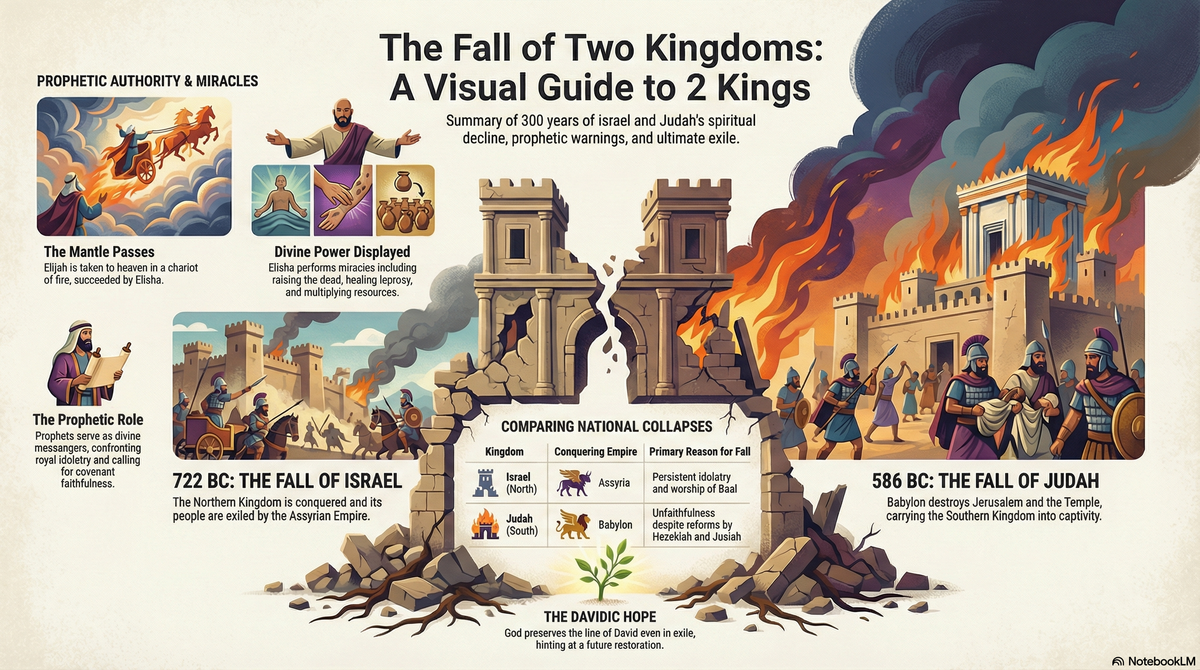
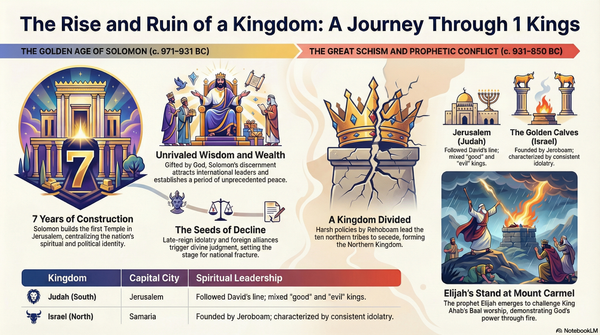
The Second Book of the Kings (also known as 2 Kings in modern Bibles, or commonly called the Fourth Book of the Kings in some traditions) continues the royal history from 1 Kings, chronicling the final centuries of the divided kingdoms of Israel (north) and Judah (south) until their tragic falls into exile.
It begins with the transition from Elijah to Elisha, covers the ministries of these prophets amid widespread idolatry, details the reigns of numerous kings evaluated by their faithfulness to the covenant, and culminates in the Assyrian conquest of Israel (722 BC) and the Babylonian destruction of Judah and Jerusalem (586 BC). Traditionally part of the Deuteronomistic history (possibly compiled during or after the exile), the book spans roughly 300 years (c. 853–586 BC).
It divides into major sections: Elisha's ministry and northern kings (chs. 1–17), with focus on Israel's fall; and Judah's later kings leading to exile (chs. 18–25), highlighting reforms under Hezekiah and Josiah amid persistent decline.
Overall Theme:
The overarching theme of 2 Kings is God's righteous judgment on covenant unfaithfulness and His persistent faithfulness despite national failure.
The book repeatedly assesses kings by whether they followed David or turned to idolatry, with most "did evil in the sight of the LORD" by promoting high places, Baal worship, and injustice. Prophets like Elisha confront kings and demonstrate God's power over false gods. Persistent disobedience leads to divine discipline: Israel exiled by Assyria for idolatry, Judah by Babylon despite godly kings like Hezekiah and Josiah.
Yet God's mercy endures—He preserves David's line, spares Jerusalem temporarily for Hezekiah's sake, and hints at future restoration. The theme underscores that obedience brings blessing, idolatry brings curse (Deuteronomy's warnings fulfilled), but God's covenant with David holds hope for an eternal kingdom fulfilled in Christ.
Location Settings:
Samaria — Capital of northern Israel (Israel); central for many northern kings (Omri dynasty onward), site of Elisha's miracles, Jehu's purge, and eventual Assyrian conquest and resettlement (chs. 6–17).
Jerusalem — Capital of southern Judah; focus in later chapters—temple central for reforms under Hezekiah and Josiah, besieged by Assyria (ch. 18–19) and destroyed by Babylon (ch. 25).
Mount Carmel — Site of Elisha's early ministry and miracles (referenced from Elijah's legacy).
Jordan River — Elijah taken up near here; Elisha parts waters (ch. 2).
Damascus (Aram/Syria) — Frequent conflicts; Hazael anointed as future oppressor (ch. 8).
Lachish and Libnah — Judahite cities besieged by Assyria under Sennacherib (ch. 18–19).
Babylon — Final exile destination; Jehoiachin released there (ch. 25).The narrative contrasts northern sites (Samaria, Jezreel) with southern Jerusalem, showing parallel but diverging paths to judgment.
People Involved
God (the LORD / Yahweh):
Sovereign Judge and merciful covenant-keeper; sends prophets, performs miracles through Elisha, judges idolatry, yet preserves remnant for David's sake.
Elisha:
Elijah's successor; performs double miracles (oil, resurrection, healing Naaman, floating axe head); confronts kings, protects Israel.
Elijah (briefly):
Taken to heaven in chariot of fire; transition to Elisha.
Jehu:
Anointed to destroy Ahab's house; purges Baal worship, kills Joram, Jezebel, Ahaziah; ends Omride dynasty but incomplete obedience.
Hezekiah:
Godly king of Judah; reforms worship, trusts God against Assyria; prays, Isaiah prophesies deliverance; sun dial miracle.
Josiah:
Reforming king of Judah; discovers law book, purges idols, restores Passover; most faithful since David, yet judgment delayed.
Ahab's house remnants (Joram, Ahaziah, Jezebel):
Wicked; purged by Jehu.
Hazael:
King of Aram; oppresses Israel.
Sennacherib:
Assyrian king; besieges Jerusalem; defeated by angel.
Nebuchadnezzar:
Babylonian king; conquers Judah, destroys temple, exiles people.
Supporting figures:
- Naaman — Syrian commander healed of leprosy.
- Gehazi — Elisha's servant; struck with leprosy.
- Isaiah — Prophet advising Hezekiah.
- Manasseh — Most wicked Judah king; idolatry leads to judgment.
- Jehoiachin, Zedekiah — Last Judah kings; exile.
- The prophets — Speak warnings; sons of prophets group.
Detailed Chapter Summary:
Chapters 1–2 – Elijah's departure and Elisha's succession
Ahaziah consults Baal-zebub; Elijah calls fire on captains; Ahaziah dies. Elisha follows Elijah; chariot of fire takes Elijah; Elisha parts Jordan, receives double portion.
Chapters 3–8 – Elisha's miracles
War against Moab; water miracle. Shunammite's son raised; poisoned stew healed; Naaman healed of leprosy (Gehazi cursed). Axe head floats; Arameans blinded; siege of Samaria lifted.
Chapters 9–10 – Jehu's purge
Jehu anointed; kills Joram, Jezebel, Ahaziah; slaughters Ahab's house, Baal priests; destroys Baal worship but keeps Jeroboam's calves.
Chapters 11–12 – Athaliah and Joash in Judah
Athaliah usurps throne; Joash hidden, crowned; Athaliah killed. Joash repairs temple but later turns.
Chapters 13–17 – Northern kings and Israel's fall
Jehoahaz, Joash, Jeroboam II (prosperity but evil); prophets warn. Israel falls to Assyria (Hoshea); people exiled; foreigners resettled in Samaria (Samaritans originate).
Chapters 18–20 – Hezekiah's reign
Hezekiah reforms; trusts God against Sennacherib. Isaiah prophesies deliverance; angel slays 185,000 Assyrians. Hezekiah's illness; sun dial sign; shows treasures to Babylonians.
Chapters 21–23 – Manasseh, Amon, Josiah
Manasseh's extreme idolatry; bloodguilt. Amon evil. Josiah reforms: finds law book, purges idols, restores Passover; most righteous king.
Chapters 24–25 – Judah's final decline and exile
Jehoiakim, Jehoiachin, Zedekiah rebel against Babylon. Nebuchadnezzar besieges Jerusalem; temple destroyed, people exiled. Jehoiachin released in Babylon.
Closing Prayer:
Righteous and merciful God, who warned Your people through prophets and judged nations for idolatry, we thank You for the book of 2 Kings that reveals the tragic cost of turning from You and the certainty of Your word fulfilled in judgment. In Elisha's miracles, Hezekiah's faith, and Josiah's reforms, we see glimmers of Your grace amid darkness; in the falls of Samaria and Jerusalem, we see the consequences of persistent sin.
Thank You for Your faithfulness to David's line, preserving hope even in exile, and for sending the greater King, Jesus Christ, whose kingdom endures forever. Teach us to heed Your warnings, repent swiftly, and worship You alone, trusting Your mercy to restore what sin has broken until we dwell in Your eternal city. To You be glory forever. Amen.