The Song of Solomon: Celebration of Covenant Love and Divine Romance — Full Book Summary and Key Themes
Comprehensive overview of the Song of Solomon — a poetic dialogue celebrating the beauty, passion, and exclusivity of marital love between the bridegroom (Solomon) and the Shulammite bride, with rich imagery of nature and royalty, reflecting God’s covenant love for His people and Christ’s love

Summary
The Song of Solomon, also known as the Song of Songs, is a lyrical poetic dialogue celebrating the beauty, intimacy, and joy of romantic love between a bridegroom (the king, traditionally identified as Solomon) and his bride (the Shulammite woman).
Presented as “the song of songs, which is Solomon’s” (1:1), it is the supreme expression of human love in the Bible, using vivid, sensual imagery drawn from nature, royalty, and everyday life. Traditionally attributed to Solomon (c. 970–930 BC), though some scholars suggest a later compilation or view the name as associating it with Solomonic wisdom and splendor, the book contains no clear historical narrative or timeline. Instead, it unfolds as a series of passionate exchanges, dreams, and choral interludes between the lovers, their friends (the daughters of Jerusalem), and occasional observers.
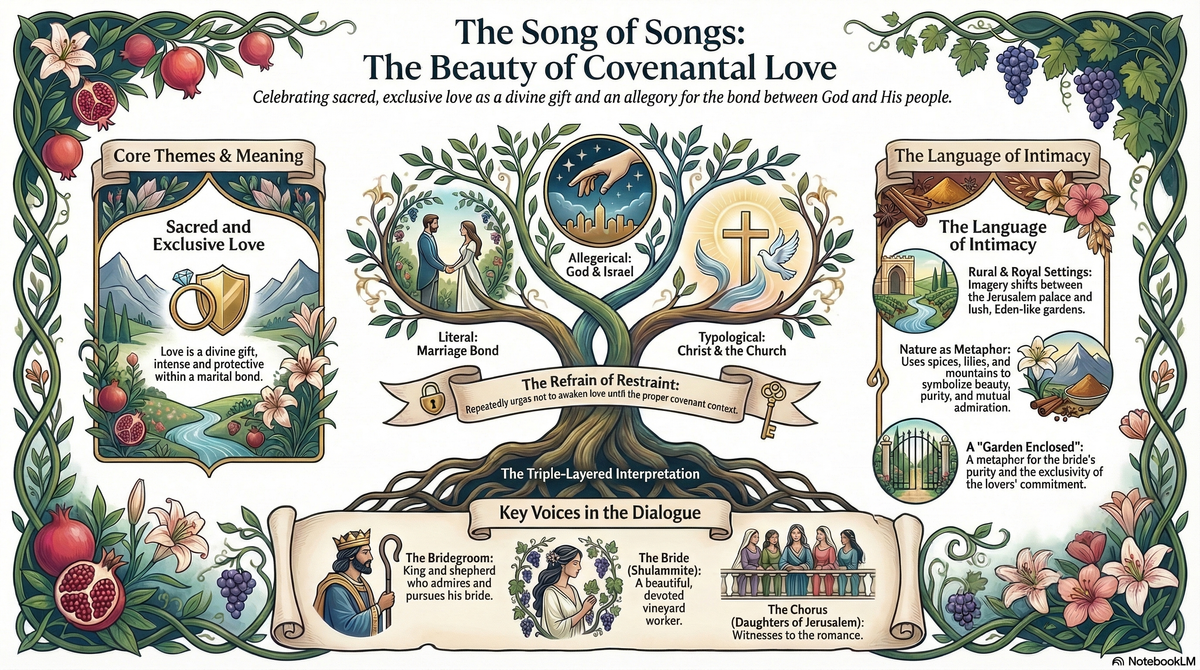
The structure is fluid and cyclical rather than strictly linear, moving between longing, union, separation, and reunion, with recurring motifs of seeking and finding. The Song is traditionally interpreted in multiple layers: literally as the celebration of marital love, allegorically as God’s love for Israel, and typologically as Christ’s love for the church or the individual believer. In the NKJV, it is a short book of eight chapters, rich in metaphor, and part of the Wisdom literature alongside Proverbs and Ecclesiastes.
Overall Theme:
The overarching theme of the Song of Solomon is the beauty, purity, and delight of exclusive, covenantal love between a man and a woman in marriage, reflecting the depth of God’s love for His people. The poem exalts human love as a divine gift—intense, mutual, exclusive, and celebratory—while portraying it as a sacred bond worth defending against all threats (jealousy, separation, temptation).
The repeated refrain “do not stir up nor awaken love until it pleases” (2:7; 3:5; 8:4) underscores the sanctity and timing of love, urging restraint until the proper covenant context. The lovers delight in each other’s physical beauty, character, and presence, using extravagant imagery from gardens, vineyards, spices, animals, and royalty to express desire, admiration, and commitment.
The book affirms sexuality as good within marriage, free from shame, and a reflection of God’s creative design. Allegorically, it points to the covenant relationship between Yahweh and Israel (Hosea, Isaiah) and ultimately to Christ’s sacrificial, pursuing love for His bride, the church (Ephesians 5:25–32; Revelation 19:7–9). The Song teaches that true love is passionate yet protective, mutual yet honoring, and ultimately points beyond itself to the greater love of God.
Location Settings:
The Song of Solomon is not bound to a single historical location but uses a rich variety of poetic settings drawn from the natural and royal world of ancient Israel, evoking both rural simplicity and royal splendor.
The royal palace / Jerusalem — Implied primary setting for the kingly bridegroom.
- References to the king’s chambers (1:4), banqueting house (2:4), couch of Solomon (3:7–10), and royal retinue suggest the palace in Jerusalem as the place of consummation and royal honor.
The countryside / vineyards / gardens / fields — Dominant natural settings symbolizing fertility, beauty, and intimacy.
- The Shulammite is from the vineyards of Engedi (1:14), works in her brothers’ vineyard (1:6), and is called to come from Lebanon’s mountains and gardens (4:8; 7:11).
- Orchards, nut groves, apple trees, lilies, roses of Sharon, and flocks on hillsides create a lush, Eden-like backdrop (2:1–3; 4:12–16; 6:2–3).
Lebanon, Mount Hermon, Amana, Senir, and Hermon — Northern mountainous regions; majestic, exotic, and romantic (4:8).
- Symbolize grandeur, purity (snowy peaks), and the wild beauty the bridegroom admires in his beloved.
The city streets / watchmen’s rounds — Nighttime urban scenes of the bride searching for her lover (3:1–3; 5:6–7).
- The daughters of Jerusalem witness and comment on the lovers’ passion.
The wilderness / pastoral fields — Shepherd imagery (1:7–8; 2:16); the bride as a shepherdess, the groom as a shepherd-king.
The garden enclosed / fountain sealed — Metaphorical of the bride’s purity and exclusivity (4:12–16); later opened in mutual delight (5:1).
The settings blend the royal and rural, the public and private, the cultivated and wild, symbolizing love’s place in every sphere of life.
People Involved
God (the LORD):
Not explicitly named, yet implicitly present as the Creator of love and the one who ordains marriage as good. The Song reflects His design for covenant relationship.
The Bridegroom (the King / Beloved / Solomon):
The male lover; portrayed as a majestic king and shepherd; admires, pursues, and delights in his bride with poetic praise and tender affection.
The Bride (the Shulammite / Beloved / Sister / Spouse):
The female lover; beautiful, humble (vineyard worker), passionate, and devoted; praises her beloved’s appearance and character; yearns for union and exclusivity.
The Daughters of Jerusalem / Friends / Companions:
Chorus of young women in the city; address the bride, express wonder at her love, and serve as witnesses to the romance (1:5; 2:7; 3:5; 5:9; 6:1; 8:4).
The Brothers of the Shulammite:
Guardians of her vineyard; treat her sternly, making her work (1:6); later acknowledge her choice (8:8–9).
The Watchmen:
City guards who encounter the bride during her nighttime search (3:3; 5:7); strike her in one scene, symbolizing opposition or misunderstanding.
Supporting figures / voices:
- The mother — Mentioned as the one from whose chamber the bridegroom comes (3:4; 8:5).
- The shepherds / companions of the groom — Invited to feast (5:1).
- King Solomon — Named explicitly (3:7–11); his wedding procession and palanquin celebrated.
The cast is intimate: the two lovers and their immediate circle, emphasizing the private yet communal nature of covenant love.
Detailed Chapter Summary:
Chapter 1 – Mutual longing and praise
The bride expresses desire for the king’s kisses; praises his love better than wine. She is dark yet lovely; seeks her beloved among the shepherds. Chorus directs her. Bridegroom praises her beauty.
Chapter 2 – Springtime love and delight
Bridegroom invites bride to rise and come away; spring has come. Mutual praise: “I am my beloved’s, and my beloved is mine” (2:16). Refrain: do not awaken love.
Chapter 3 – Night search and royal wedding
Bride searches city for beloved; finds him, brings him to mother’s chamber. Solomon’s wedding day: magnificent palanquin, guarded by warriors, crowned with joy.
Chapter 4 – Bridegroom’s praise of the bride
Detailed admiration of her beauty (eyes, hair, teeth, lips, neck, breasts); she is a garden enclosed, fountain sealed. Bride invites him to come to his garden.
Chapter 5 – Bride’s dream / search
Bridegroom knocks; bride delays, he leaves. She searches city, beaten by watchmen. Describes his beauty to daughters of Jerusalem.
Chapter 6 – Chorus and bridegroom’s praise
Daughters ask where he has gone. Bridegroom returns to praise her uniqueness; she is perfect, awesome as an army with banners.
Chapter 7 – Mutual admiration
Bridegroom praises her beauty in detail (feet, thighs, navel, breasts, neck, eyes). Bride responds with invitation to the fields and vineyards.
Chapter 8 – Climax of love and commitment
Bride longs for closeness from childhood; love strong as death, jealousy cruel as the grave. Seal me on your heart. Brothers discuss her dowry. Final declaration: “I am my beloved’s, and his desire is toward me.”
Closing Prayer:
Loving and faithful God, who created us male and female in Your image and declared marriage good, we thank You for the Song of Solomon that celebrates the beauty and holiness of covenant love. In the passionate exchanges of the bride and bridegroom, the delight in one another’s presence, and the fierce commitment to exclusivity, we see a reflection of Your own steadfast, pursuing love for Your people. Thank You for portraying human love as a divine gift—joyful, pure, protective, and life-giving—within the bounds of marriage. Forgive us when we cheapen love or seek fulfillment outside Your design. Grant us grace to cherish our spouses (or wait patiently in purity), to speak words of affirmation and admiration, and to guard love’s sacred flame.
Above all, we praise You for the greater Bridegroom, Jesus Christ, who loved His bride the church and gave Himself up for her, who calls us into intimate union with Him, and who will one day present us spotless at the marriage supper of the Lamb. May our lives echo the Song’s refrain of belonging—“I am my beloved’s, and my beloved is mine”—until we rest fully in Your perfect love forever. To You be glory forever. Amen.